Rowans bowling alley is loved by all. Why does the council want to tear it down?
The fight to save a busy, profitable and beloved bowling alley from becoming flats is not about nostalgia, says Jack Burke. It is about how culture has become expendable – and why that should worry anyone who cares about their city’s future


Rowans, the beloved 24-hour bowling alley in north London, is under threat. Whispers emerged last week about a consultation on whether to bulldoze it to build 190 flats on its Finsbury Park site.
The outrage was, inevitably, virulent. Rowans holds a sentimental place in the hearts of many Londoners – not least me, who grew up 15 minutes away in Muswell Hill. It is a weird, liminal space: the site of the best and worst night you will ever have. Sticky floors. A casino-like sprawl perfumed with the ghost of teenage Lynx. Bowling pins crash to your left, lagers slosh through the air and Eurotrash belts from the jukebox. I even think there is an arcade.
Rowans has always operated less as a venue than as a kind of social undertow, pulling in the lost and the lively alike – the teenagers with fake IDs and the beetroot-faced regulars. And crucially, it is never empty. This is not a misty-eyed eulogy for a place already in decline. Rowans is more popular than ever, as the uproar showed when Haringey Council announced, with about five days’ notice, its plans for a public consultation on the bowling alley’s future.
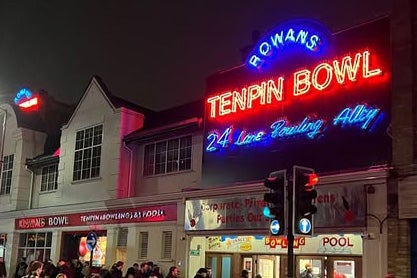
I stress this because Rowans is not some sentimental husk being kept alive by nostalgia alone. It is popular, profitable and embedded. On most nights it is heaving – full of people who have chosen it deliberately over the bloodless new-build high-rise hellscape now encircling Finsbury Park station. The neighbourhood is increasingly defined by identikit towers, managed lobbies and aspirational balconies promising “vibrancy” while repelling anything that resembles it.
And yet Rowans now finds itself staring down the barrel of a compulsory purchase order, courtesy of Haringey Council, which would effectively strip the owners of their property and fold the site into a redevelopment scheme framed, with weary predictability, as a response to the housing crisis.
Compulsory purchase orders are an extraordinary power. They were conceived as a last resort – a blunt but necessary instrument reserved for moments of genuine public necessity: railways that could not be rerouted, hospitals that could not be built piecemeal and infrastructure projects whose benefits were so clearly collective that individual consent, reluctantly, had to give way.
They were not designed for councils eyeing up successful, culturally significant venues and thinking, “we could probably make more money if this were flats.”
Yet that is increasingly how they are being used. Cash-strapped councils across London, hollowed out by austerity and desperate for revenue, now behave less like custodians of place and more like players in a high-stakes game of Monopoly – hoovering up assets in the hope of future council tax receipts and hefty redevelopment fees. The worst part is that they have convinced themselves this is progress. “Housing crisis,” they say, as if the phrase were a trump card, absolving every subsequent decision and turning civic vandalism into moral necessity.
Haringey’s proposal insists Rowans destruction is about development and renewal, about unlocking land to meet housing need. It is buzzword bingo, offering a future that exists only as fuzzy abstraction: opportunity, regeneration and mixed-use potential. What it conspicuously lacks is any serious reckoning with what would be destroyed in the process.
Councils exist for their residents. That is the embarrassingly simple social contract at the heart of local government. They are meant to protect the fabric of the places they govern – to act as stewards, not speculators. When they start eyeing up beloved, busy, culturally significant institutions, something has gone badly wrong.
Housing is needed. No one disputes that. But here the housing crisis is wielded as a moral cudgel, framing opposition as selfishness and resistance as nostalgia. Nor is the promise of “affordable” remotely reassuring. In London, affordable means 80 per cent of market value – which, in this sooty corner of north London, translates to £400,000 or £500,000.
This is not housing for the people who bowl at Rowans on a Tuesday night. It is housing for an abstract future resident who exists primarily in planning documents.
Haringey’s proposal barely pauses to consider what disappears when a place like Rowans is wiped from the map. A whole connective tissue of life gathers around it: surrounding businesses that benefit from its gravitational pull, cafés and takeaways that thrive because people are already out. Once the anchor is gone, that informal economy of chance encounters and repeat visits collapses almost instantly.
Nor does the plan seriously engage with the environmental cost of intensifying development beside one of north London’s major parks – squeezing yet more glass and concrete into a space that already groans beneath it.
Rowans belongs to a class of venues London has been losing, one by one, for over a decade: stalwarts of nightlife and leisure that endured because they were woven into the city’s habits rather than its hype. They offered familiarity, not the brittle thrill of novelty. They were the places that made London feel like a city rather than a property portfolio. And the past decade has seen a procession of campaigns to save them, often accompanied by the sinking suspicion that these battles are lost long before anyone outside a council office hears about them.
This is not a battle between housing and culture, however convenient that framing may be. It is a choice between short-term accounting and long-term belonging – between a city that understands its remaining weirdness and texture as an asset and one that treats it as an inconvenience to be tidied away.
If Rowans goes, it will not be because London needed homes too badly to keep it. It will be because, when forced to choose, those in power decided that places like Rowans no longer counted as part of the public good at all.
Join our commenting forum
Join thought-provoking conversations, follow other Independent readers and see their replies
Comments
Bookmark popover
Removed from bookmarks