Will pedestrianising Soho save it… or destroy it?
Plans to make one of central London’s most famous party districts traffic-free sound like a no-brainer… but it could have unintended consequences, says James Moore


Working in Soho, as I once did – and not, as a go-go dancer, as my editor cheekily suggested – can be a blast. A modest grid of tightly-knit streets in central London that was home to waves of refugees fleeing poverty and religious persecution, it has more recently been a place to roister and carouse.
Some of the capital’s best pubs, clubs, music venues and restaurants are here. Interesting shops, too – ie, not the usual high street chains. It’s an accepting, diverse and, above all, fun place that, for a couple of decades at least, found itself as the epicentre of London’s gay life.
Its other accolade is as the last corner of central London not to be hit by the developer’s wrecking ball – but its essential tumbledown charm is under increasing threat.
Soho is an iconic destination and, if it ain’t broke, leave it as is. But an influential lobby is trying to fix it anyway, with architects John Lacey of Doodle Architecture and Russell Potter of Soda Studio spearheading a new proposal to pedestrianise its streets permanently.
The idea was briefly put to the test during the pandemic, when bars and restaurants set up tables and chairs in the street, but plans for a permanent change permit more outdoor drinking and dining, in what are essentially rat-runs for taxis dashing between Oxford Street and Shaftesbury Avenue, never really took off.
“London is at its best when it gives space to people, not cars,” says Stephen Fry, a supporter of the proposal. “Soho is one of our most precious cultural quarters. It represents a haven for creativity, conviviality and community within central London.”
Banning traffic from the area sounds like a no-brainer. But my concern with the current plans to make the area pedestrian-only is that they may end up trampling roughshod over what makes the place great.
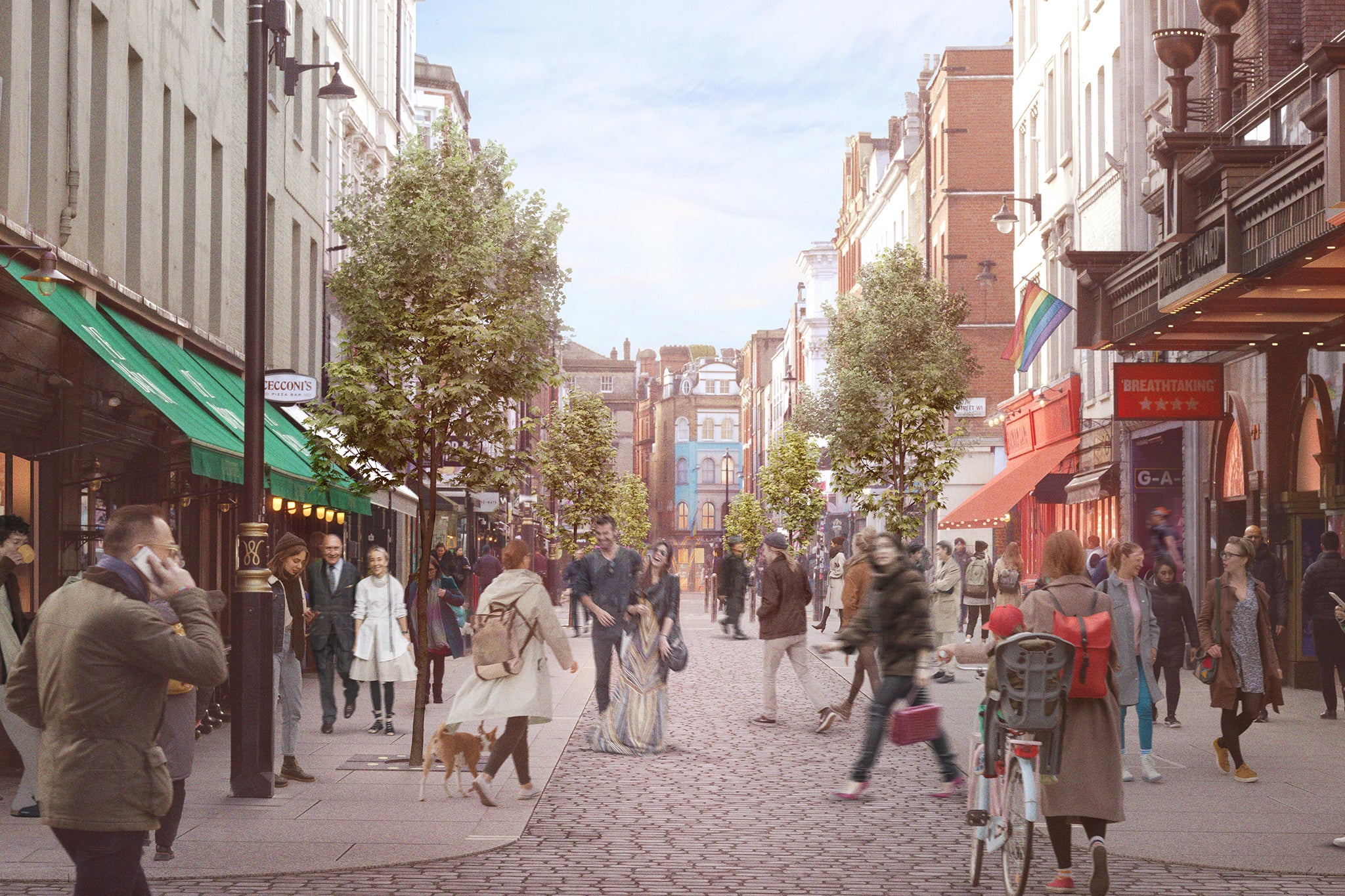
Artists’ impressions of a cobbled Old Compton Street are designed to show off the idea in its best light. But somehow, without the grimy roads, they’ve stripped the soul from the place.
Peter Murray, co-founder of New London Architecture, told the London Standard that “well-designed, low-traffic zones enhance urban vibrancy, improve community well-being and boost local businesses – proven by places like Paris, Melbourne, Barcelona, Amsterdam and Copenhagen”.
Cor blimey, guv – we could be like them Parisians! Ooh la bloody la.
Londoners know what happens when developers are allowed to “improve” an area that has grown up organically over time. Plenty of dismal low-traffic neighbourhoods (LTNs) around the capital – rammed through by tinpot town-hall tyrants in the teeth of local opposition – are testament to their sledgehammer approach.
It may surprise you to learn that people live in Soho. They deserve a say in what happens to their neighbourhood, too. But when ambitious politicians want to leave a mark, when celebrities get a bee in their bonnet, and developers smell a fast buck to be made, listening to locals is rarely much of a consideration.
There is a long list of people beating the drum for pedestrianisation, which I worry will be the first step to a blandification of the wider area. Berwick Street – the market street made famous by Oasis's (What's the Story) Morning Glory? album cover – lost something of its old self when it was pedestrianised to increase the footfall (ugh…) to the new retail units (ugh…) created by building blocks of flats along it. The futuristic, gold-fronted developments along Charing Cross Road, Soho’s easternmost edge, are shockingly out of keeping with the area.
One of Soho’s landmarks, the G-A-Y bar on Old Compton Street announced its closure earlier this month, with the owner saying that the area had lost its identity.
Pedestrianising Soho risks spoiling its party and neutering the place. Sadiq Khan, the London mayor, is keen to push through his plan to pedestrianise nearby Oxford Street, Europe’s longest shopping street, before he runs for re-election next year. Can we wait and see how much of a disaster that is first?
And – whisper it – the traffic in Soho doesn’t much get in the way of things; it keeps tipsy and tottering revellers on their toes. The worst thing about Soho isn’t the taxis and minicabs looking to take you home after a good night out. But the blaring rickshaws? That’s another matter. Let’s get rid of those gaudy, noisy rip-offs, then we can talk about how Soho can be improved.
Join our commenting forum
Join thought-provoking conversations, follow other Independent readers and see their replies
Comments
Bookmark popover
Removed from bookmarks