Badenoch had Starmer on the ropes – so why no knock-out blow?
Labour MPs looked thoroughly demoralised at PMQs, not least at Keir Starmer’s failure to reply to a reasonable question – why shouldn’t the Commons have a debate on his pledge to deploy British troops in Ukraine? Did he have another military action on his mind, asks John Rentoul


No one would ever accuse Keir Starmer of dominating the House of Commons. He comes to the chamber cheerfully enough, pauses to chat to the speaker, acknowledges his colleagues politely… But by the time he gets to the despatch box, he is in a defensive crouch, head down, reading from his notes.
Today, he was more defensive than usual, because he knew what Kemi Badenoch was going to ask.
She was going to want to know why he wasn’t going to give all MPs a chance to question him about the agreement he signed in Paris yesterday, pledging to deploy British troops to Ukraine as part of a peacekeeping operation if there is a ceasefire.
The prime minister tried to pre-empt the assault by setting out his argument in his preamble. This introduction is becoming increasingly controversial with the MPs opposite, who have noticed that Starmer often uses it to try to score points before he is asked any questions.
Today was a particularly provoking example. He made a decent joke about Reform, whose leader Nigel Farage was boycotting Prime Minister’s Questions, wishing his MPs a happy Christmas, “because today is the day they celebrate Christmas in Russia”.
Then he listed the government’s achievements – “breakfast clubs” as we “turn the corner” – and next said he was in Paris yesterday. He described the deal, and said “we will set out the details at the earliest opportunity”. But not today.
All MPs got today was a promise that, “were troops to be deployed under the declaration signed, I would put that matter to the House for a vote”.
Far from taking the sting out of the issue, all this did was wind up the Conservative benches in full-throated support of their leader. Badenoch, brimming with the confidence of someone who is rising in the opinion polls, said it was “frankly astonishing” that Starmer was not making a statement.
Starmer repeated what he had said in the preamble and pointed out that he was answering questions now, despite the Tories trying to shout him down. But he sounded irritated about being held to account, and Badenoch said: “He’s scared of us being able to ask questions.” She said if he could skip PMQs, “he would do”, which seemed to strike a chord with the glum faces on the Labour front bench.
Yvette Cooper and Rachel Reeves, on either side of the prime minister, looked as if they were wondering whether to resign. The front bench generally looked as if they were as hostile to Starmer as anybody on the other side.
By the time he came to answer Badenoch’s third question, in which she noted that Starmer had not yet had a phone call with Donald Trump, the prime minister seemed to be all over the place.
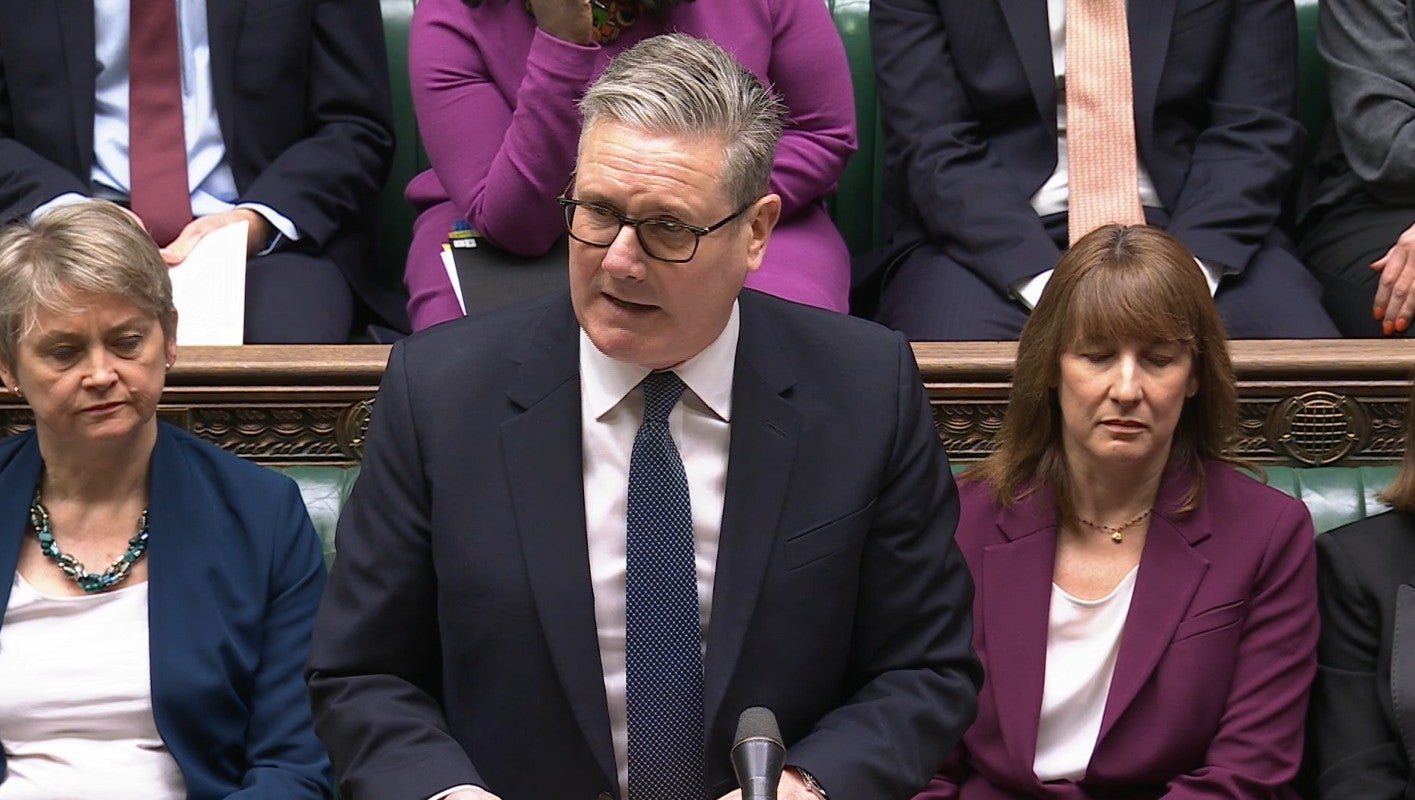
Perhaps his mind was occupied with another military operation. He had presumably given the go-ahead just before PMQs to British ships and aircraft assisting the US in seizing the Russian-flagged oil tanker Marinera, which was announced a few hours later.
Whatever the reason, Starmer had no explanation for the delay in allowing MPs a full debate on the important question of sending armed forces abroad. It is, in fact, a recent convention that the Commons should vote on military deployments – one first accepted by Tony Blair in a vote on the principle of air strikes against Saddam Hussein’s regime in Iraq in 1998.
Since then, Labour’s soft-left has elevated the convention to the status of sacred constitutional right. Gordon Brown, when he was trying to posture to the left of Blair, proposed to enshrine it in law – although he never got round to it. Starmer himself venerated the principle, standing for the Labour leadership on a pledge to bring in a “Prevention of Military Intervention Act”.
But now he did not seem to think that MPs should even get to ask questions about military deployments, and certainly not to vote on them until they happen. (The remarkable thing about Blair’s 1998 vote was that he held it on the principle of airstrikes many months before the order was finally given.)
Badenoch failed to press home her advantage. She could have simply repeated the question and pointed out that Lindsay Hoyle, the speaker, agreed with her that Starmer should be making a statement.
Instead, she diverted into related subjects. She asked when the target for defence spending of 3 per cent of national income would be met. By now, the prime minister had recovered his balance somewhat and counterattacked by quoting Ben Wallace, the Tory former defence secretary, who accused the Tory government of leaving the armed forces “hollowed out”.
But Labour MPs looked thoroughly demoralised by the failure of their leader to answer what they thought was a reasonable question about why they shouldn’t have a debate and a vote on a potentially significant step in foreign policy.
Join our commenting forum
Join thought-provoking conversations, follow other Independent readers and see their replies
Comments
Bookmark popover
Removed from bookmarks