Trump’s man in Moscow: is ‘Dim Philby’ Steve Witkoff about to seal a Ukraine peace deal?
As criticism mounts over leaked calls and alleged Russian influence, the businessman-turned-envoy’s journey to Moscow for talks with Vladimir Putin may prove whether he is a diplomatic liability or the unlikely key to ending the war. Who knows, his basic boardroom charm may end up saving thousands of lives, says Mary Dejevsky


If anyone has had more negative press than Donald Trump in the latest flurry of US efforts to end the war in Ukraine, it is Steve Witkoff, the man he appointed as his special envoy at the very start of his second term. One Western critic even dubbed him “Dim Philby”. But the knives have been out for Witkoff in Washington pretty much from the start, and the charge sheet against him is long.
The scrutiny has intensified with news that Witkoff is expected to travel to Moscow for talks with Vladimir Putin, a sign of how urgently the White House wants movement on Ukraine.
The latest case against him, which comes with calls from Trump opponents for his dismissal, relates to a five-minute phone call that was leaked to Bloomberg News. The call, on 14 October, was with Yuri Ushakov, Vladimir Putin’s foreign policy adviser, and had Witkoff advising how best to handle Trump – which included flattering the US president’s peace-making ambitions, praising the agreement on Gaza, and supporting a similar multi-point approach to ending the war in Ukraine.
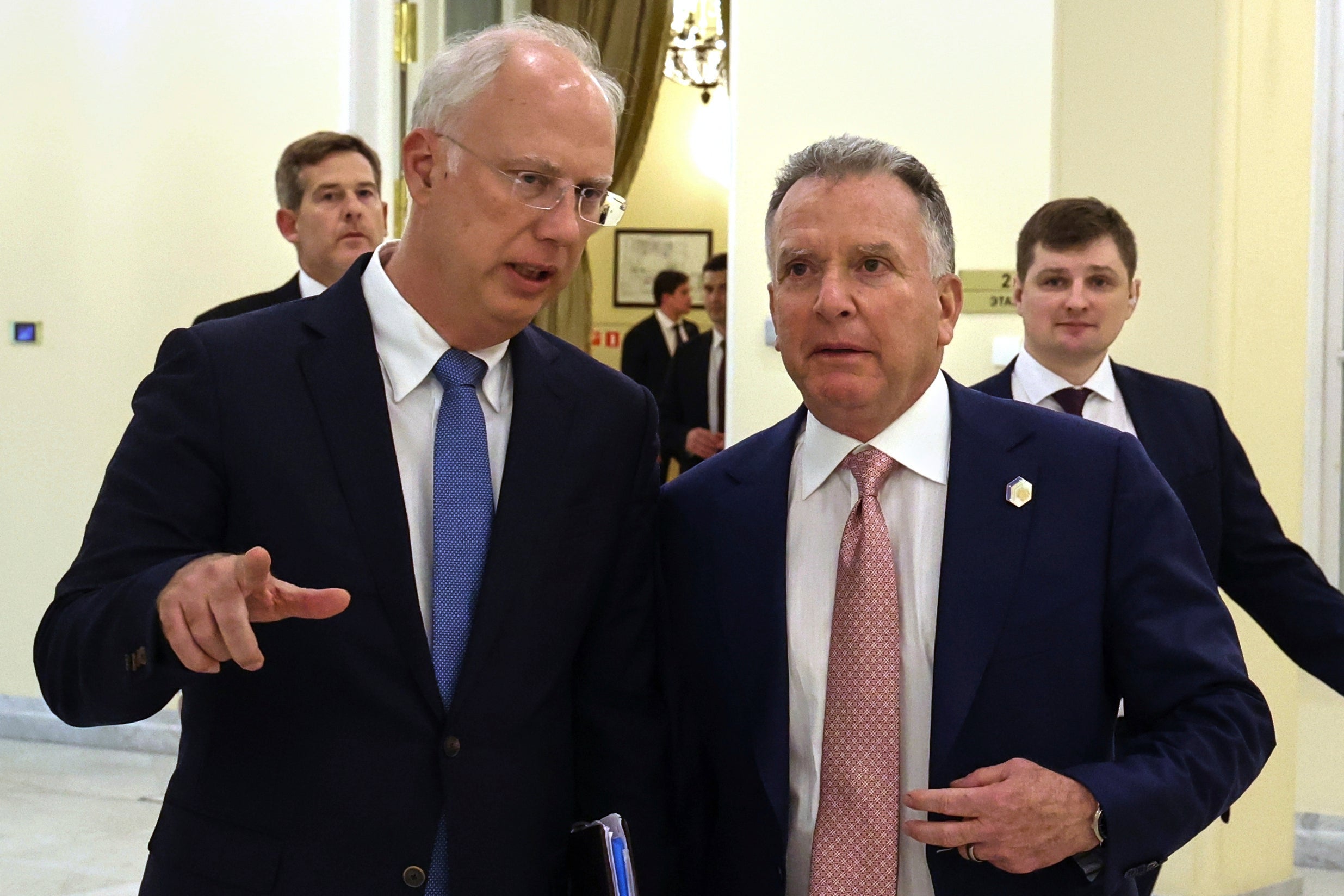
The popular theory in the US is that it must have been leaked by the Russians, perhaps to show the extent to which Trump was still onside. Equally, though, Trump has enough detractors of his shifting Ukraine policy at home with an interest in branding the president a puppet of the Kremlin – which is how the call, with its friendly tone, was largely presented. The Russians, for their part, blamed, among others, the Europeans, who, they said, wanted to stop any Trump-Russia-Ukraine deal in its tracks. The timing of the leak, coming days before Witkoff’s expected arrival in Moscow, has fuelled suspicions that various actors are now openly attempting to shape or sabotage the peace push.
Another leaked call is also doing the rounds, this time between two Russian officials, Ushakov and Putin’s chief Ukraine negotiator, Kirill Dmitriev. They discuss the genesis of the first (leaked) 28-point plan and claim officials from the US, Russia and Ukraine were all involved in the process. Dmitriev has called it “fake”, but the leak would appear to be an attempt to put Ukraine’s involvement on the record.
Taking both alleged calls together, a reasonable conclusion might be that talks have reached a particularly sensitive point, that a great deal is at stake on all sides, and that there are those – not just, it might be said, in Russia and the US – who want the process to fail and are gunning for Witkoff, seeing him one way or another as a weak link.
Not by chance, perhaps, both leaks coincided with the news that Witkoff is to go to Moscow next week, in a move widely seen as intended to keep the stuttering process alive. Presenting Witkoff as too chummy with the Russians and, by extension, biased against Ukraine, could be seen as weakening his hand and even discrediting the mission. The optics are delicate: Witkoff is travelling at a time when the administration is desperate to show momentum, yet any hint that Putin is dictating terms risks undermining Washington’s entire approach.
He is damned at the outset simply by virtue of being a longstanding friend and trusted business associate of Trump. The fact that he had no experience of international diplomacy put the noses of the professionals out of joint, and his failure to have mastered the finer points of Ukraine’s war geography, as revealed in a long interview he gave to the conservative journalist Tucker Carlson earlier this year, allowed them to make that point. Agreeing to be interviewed by Carlson – the former Fox News host whose own overtures to Moscow have been well publicised – was another mark against him.
Add to this his role in Trump’s peace efforts in the Middle East – which led to accusations that he was overstretched – and the fact that he has not only been granted several long meetings with Putin, whom he has studiedly not described as enemy number one, and it was inevitable that he would be dubbed a Putin stooge.
Then again, many of the charges levelled against Witkoff can be turned the other way. It is crucial that any special envoy enjoys the confidence and trust of Trump, and business, not politics, is where his friends tend to be. Nor should it be axiomatic that a successful businessman will have no aptitude for diplomacy; the very opposite could be true.
Witkoff also has other qualities that were on display in his much-maligned interview with Carlson. He comes across as open and affable; comfortable in his own skin, modest (for someone in his position), humane, and patient – all qualities that may have recommended him to Putin at their first meeting. That encounter could have been over in minutes, had Putin taken against him; in the event, it went on for several hours.
Witkoff would also appear to share with Trump the ability – honed in business – to gauge how things might look from the other party’s perspective and tailor his approach accordingly. It’s a simple schtick, but it works a treat. This does not make Witkoff a Putin apologist; it makes him a qualified negotiator if he understands the priorities of not just one, but both parties of a conflict.
It could be that Witkoff’s latest mission to Moscow comes to nothing; that Putin rejects whatever terms are in any draft agreement, and chooses to fight on. In that case, it will be the image of a starry-eyed Putin-sympathiser, an amateur, out of his depth in the big wide world of top-flight diplomacy, that will stick, even as Trump passes responsibility for Ukraine’s fate to the Europeans.
But it could also be that Witkoff’s evident ability to talk to Putin and his deal-making acumen could foster the trust that will be essential for Moscow to make concessions. In which case, both his friends and those who wanted him sacked will be right: he will have been key to an agreement that the enemies of both Trump and Putin opposed, but may also come to be seen as having saved Ukraine as a sovereign state and countless lives.
If his Moscow visit results in even modest movement, Witkoff’s role may look rather different from the caricature that has trailed him since his appointment.
Join our commenting forum
Join thought-provoking conversations, follow other Independent readers and see their replies
Comments
Bookmark popover
Removed from bookmarks