The Independent's journalism is supported by our readers. If you submit a form or click links to other sites on this page, we will earn commission.
How much do solar panels cost? UK 2026 prices guide
This guide explains how much solar panels cost in 2026, what affects the price, and how long it typically takes for a system to pay for itself

As of January 2026, the cost of solar panels for a typical three-bedroom home in the UK usually lands between £6,500 and £9,000, depending on system size, panel type, installer pricing and whether you add a battery.
A standard 4-5kW system often costs around £6,500 to £8,000 fully installed. Add a 5kWh solar battery and you’ll typically pay £4,000 to £6,000 more up front – but you may use much more of the electricity you generate, which can improve long-term savings.
Through the Smart Export Guarantee (SEG), homeowners can earn money for surplus electricity exported back to the grid. Combined with lower reliance on daytime grid electricity, this is why many systems reach payback in around eight to 12 years (the exact figure depends on your home, usage and tariff).
With energy prices still volatile and incentives continuing to evolve, it’s no surprise that many homeowners start by asking: are solar panels worth it? Following close behind is a more practical question – what is the true cost of solar panels for your home, and how do different systems compare? In this guide, we break down how solar pricing works, what affects return on investment, and the features that separate the best solar panels on the UK market today.
We’ll also cover payback periods, financing options, the latest incentives available to UK households and share real-world experiences from both installers and homeowners, such as Greenfield and Webb.
Get a quote for solar panels on your home
Use our comparison tool to get a range of free quotes from leading solar panel installers across the UK.


Installer Lloyd Greenfield, founder of Glow Green, explains there has been a notable market shift since the energy crisis: “During the energy crisis, solar panel costs spiked, but since then we’ve seen significant price drops as manufacturers recovered stock. Today, the pound-per-watt cost has stabilised, even as panels get physically larger and more powerful.”
Homeowners echo the logic of investing in control over energy costs. As Justin Webb, who installed panels on his Somerset home three years ago, says: “I liked the idea of generating my own electricity, which would put me in control of my energy price. Along with petrol, it was the biggest variable in our household bills.”
At a glance: what you might pay
Below you’ll find the typical installed solar panel cost by household size. This calculation is based on panels + inverter + installation.
Home type (rough guide) | Typical system size | Typical installed cost | Add a battery (optional) | Typical total with battery |
Two-bed / small home | 3kW | £5,000-£6,500 | +£4,000-£6,000 | £9,000-£12,500 |
Three-bed / typical family home | 4-5kW | £6,500-£8,000 | +£4,000-£6,000 | £10,500-£14,000 |
Four-bed / higher use | 5-6kW | £7,500-£9,500 | +£4,000-£8,000 | £11,500-£17,500 |
Typical payback from solar panels
- Without a battery: often nine to 12 years
- With a battery: often eight to 12 years (can be shorter for high evening use / EV owners)
Payback is driven by three things:
- Bill savings: how much of your solar electricity you use at home instead of buying from the grid (households with more daytime use tend to do best)
- Export earnings (SEG): how much surplus you send back to the grid and the rate you’re paid per kWh
- Energy prices: when prices are high, as they have been in recent years, your return on investment accelerates the more energy you can generate yourself, and use
A few factors can shift the payback noticeably:
- System cost: a lower quote with the same performance shortens payback fastest
- Your usage pattern: shifting energy use into daylight hours increases savings
- Battery storage: can increase self-consumption (and cut grid imports), but adds upfront cost
- Roof and location: shading, orientation and region affect how much the system generates
- Tariffs and SEG rates: export rates vary by supplier, and energy prices change over time
It’s important to remember that these are ranges, not promises. Your roof, shading, electricity use (especially daytime vs evening), installer pricing, and your export rate can all swing the maths. Where you live in the UK also plays a role, as the south gets more annual sun than homes in the north.
How much do solar panels cost in the UK?
The price of each solar panel can range from about £100 to £500, so they make up a relatively small proportion of the overall cost, which includes fitting and connection. This is because the price of labour has surged over the same timeframe, and for domestic installations, fitting can be your biggest cost.
When you pay for a solar installation, you’re not just buying panels. You’re paying for a whole system, and that system has a few big-ticket items that tend to show up on every quote.
What’s usually included in an “installed” solar panel price?
Most domestic quotes typically include:
- Solar panels and mounting system
- Inverter (to convert DC electricity into AC for your home)
- Installation labour and electrical work
- Scaffolding (where needed)
- Testing, certification and commissioning
Often not included (or priced separately): batteries, complex scaffolding, roof repairs, bird-proofing, upgrades to your consumer unit, or anything unusual about access.
Where your money goes
Your quote for solar panels will be typically based on the following things:
System size (kW)
Bigger systems cost more up front, but can be better value per watt because fixed costs (survey, scaffolding, labour) are spread across more panels.
Type of solar panel
The panels themselves often account for roughly a quarter to a third of the total. Monocrystalline panels are usually the most expensive but also the most efficient. Cheaper panel types can bring the upfront price down, but may produce less electricity for the same roof area.
Installation costs
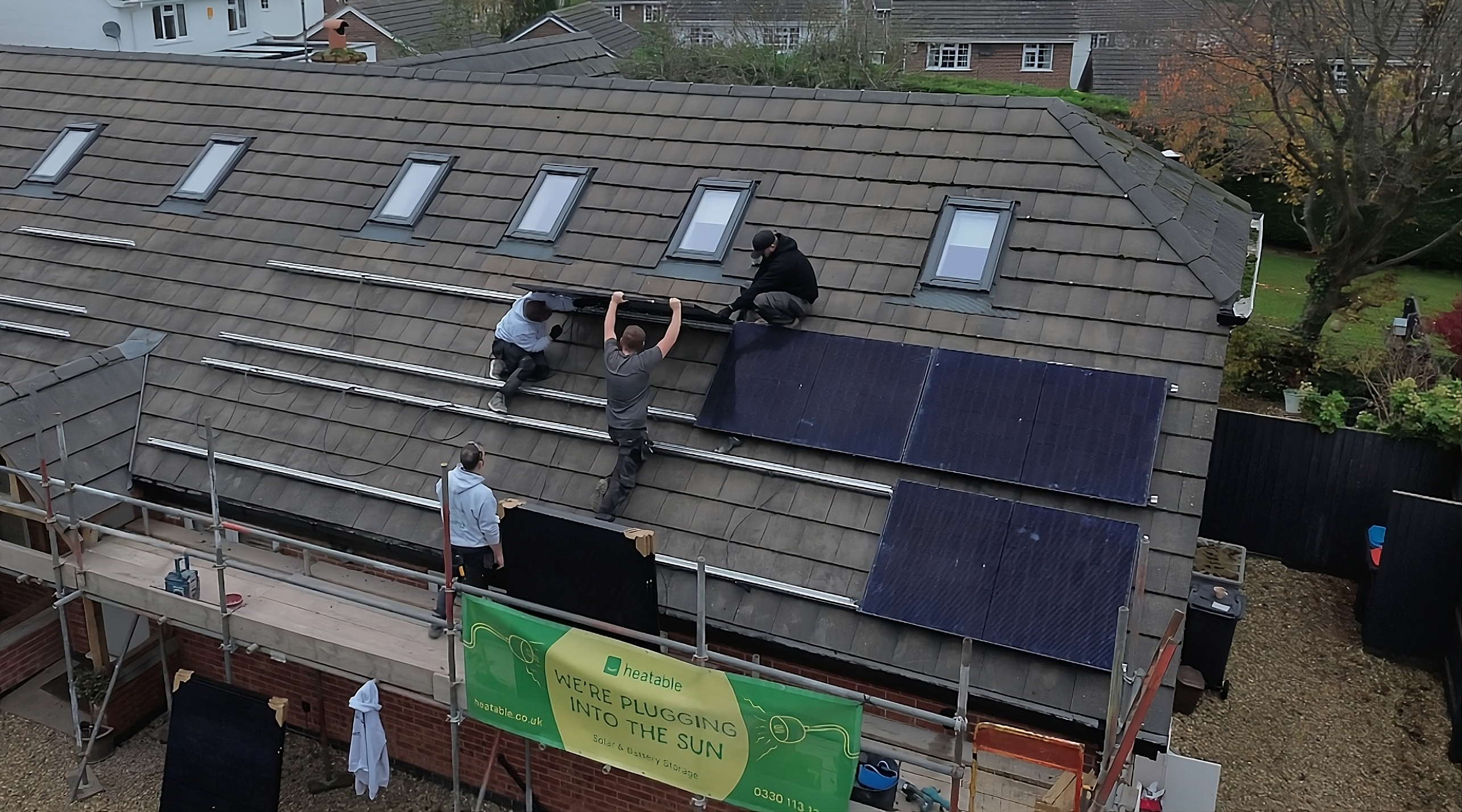
Installation (including scaffolding, labour, wiring and certification) is frequently one of the biggest cost drivers. Even as panel prices have fallen, labour costs haven’t and scaffolding can run into the thousands on tall or awkward roofs. While the panels themselves account for a third of your cost, the installation can account for up to 20 per cent.
Inverter
Inverters are typically £600 to £1,000 and often need replacing once in a system’s lifetime (commonly after 10-15 years). Micro-inverters can improve performance on shaded roofs, but can add an extra £500 to £1,000 to the upfront price.
Adding a solar battery
A battery is often the largest optional add-on. A typical 5-10kWh battery can cost £4,000 to £8,000. The upside is higher self-consumption: with a battery, many households can use over 70 per cent of what they generate, compared with roughly 30 per cent without storage.
Roof repairs
If your roof is in poor condition, you may need repairs first. That’s not usually part of a standard solar quote, but it matters because panels are designed to sit there for decades.
Quick solar panel cost scenarios: what you might pay for your home
These are deliberately simple examples to help you check quotes. Your installer should tailor everything to your roof, shading and annual usage.
Scenario one: two to three-bed home with average usage
- System: 3-4kW
- Typical installed cost: £5,000-£7,500
- Best for: households at home during the day (or able to shift usage to daylight hours)
Scenario two: three to four-bed home with higher electricity use
- System: 4-5kW
- Typical installed cost: £6,500-£9,000
- Best for: families with higher annual consumption (especially if you can use energy while it’s being generated)
Scenario three: EV owner or heavy evening use
- System: 5-6kW (often paired with a battery)
- Typical installed cost: £7,500-£9,500
- With battery: add £4,000-£8,000
- Best for: people who want to store daytime generation and use it later (evenings, overnight top-ups, etc.)
What affects the cost of solar panels?
A quote can be £5,500 for one home and £11,000 for another – even if both are three-bedroom houses. Here’s why.
Panel type and wattage
Higher-wattage panels may cost more, but can generate more electricity from the same roof space. As Greenfield points out, focusing only on the cheapest price can mean being quoted lower-wattage panels.
Roof suitability
Orientation, shading, pitch and usable area affect both how much you can fit and how much it will generate. Webb stresses the importance of a quote that reflects your property’s specifics, not just satellite estimates.
Installation complexity and scaffolding
Access issues, roof height, tricky layouts, and the amount of scaffolding needed can materially change the price.
Installer rates and aftercare
Local installers can be competitive, while national firms may cost more but have bigger support operations. Accreditation matters too. At a minimum, your installer needs to be certified under the Microgeneration Certification Scheme (MCS) if you're to qualify for Smart Export Guarantee payments, as well as your home insurance. Also look for membership in consumer protection codes such as the Renewable Energy Consumer Code (RECC) or Home Insulation & Energy Systems (HIES) Quality Assurance Scheme.
How you pay
Cash usually delivers the best ROI. Financing spreads the cost but can erode savings if the APR is high.
Solar battery costs: how much extra, and when it’s worth it
A battery connected to your solar panel system can be the difference between a nice idea and making meaningful savings, but it’s also the part of the quote that can make your eyes water.
Typical battery costs
- 5kWh: often £4,000-£6,000 added to your project cost
- 5-10kWh: commonly £4,000-£8,000 depending on brand and capacity
When a battery tends to make sense
- You use a lot of electricity in the evening
- You have (or plan to get) an EV
- You want to maximise self-consumption (and reduce exports)
- You’re on a tariff where timing your usage matters
When it may not
- You’re rarely home in the day and you’re not planning to shift usage
- Your budget is tight and you’re better off starting with panels first
- You have limited space for the battery setup
Solar panel savings and payback explained
The simplest way to think about solar payback is: how much electricity can you avoid buying from the grid, and how much can you earn from exporting what you don’t use.
Typical annual savings (rough guide)
Savings depend heavily on your usage patterns, tariff, and how much of your solar you consume on site. As a broad rule, households that can use solar electricity while it’s being generated tend to see the strongest savings.
Typical payback periods
Many UK households see payback in eight to 12 years, combining bill savings with SEG income. Larger systems can pay back faster on a per-watt basis, but only if you can actually use the energy they generate.
Solar panel ROI examples at a glance
System size | Typical installed cost | Typical annual output | Typical annual savings | Typical payback |
3kW | £5,000-£6,500 | 2,800kWh | £450-£500 | 11 years |
4-5kW | £6,500-£8,000 | 4,200kWh | £650-£750 | 9–10 years |
These are indicative examples to show how the maths changes with system size. Your own payback depends on your roof, location, tariff and (crucially) when you use electricity. For a more detailed look at how solar panels pay back and when you can see a return on your investment, see our guide to Are solar panels worth it?
Real-world worked example: what one homeowner’s payback looks like
How much you save with solar panels depends on how much electricity you use (and when you use it), plus how much sunlight your roof receives. To show how the maths can work in practice, we spoke with Wendy Conner, a homeowner in Bristol, who modelled her bills with and without solar before installing a system.
“I wanted to know exactly what I was getting into,” Conner says. “Once I saw that the panels could cover a big chunk of my usage and even earn me money back through the grid, it made the decision much easier.”
Using MCS sunlight data for Bristol (Zone 5E, irradiance factor 928) and a simple formula – system size × irradiance factor × shade factor – Conner estimated year one generation for her 5.5kWp system with no shading at around 5,064kWh.
Before solar, her annual electricity use was estimated at 10,276kWh. At a unit rate of 28p/kWh, that’s £2,877, plus an annual standing charge of around £164 (45p/day), giving a total bill of roughly £3,041.
In year one, Conner assumed 32 per cent of her solar generation would be used directly in the home (about 1,620kWh), saving roughly £450 at 28p/kWh. The rest was exported under the Smart Export Guarantee (SEG), earning about £127 – a combined year one benefit of around £577.
Her system cost around £8,750, putting the year one nominal return at roughly 6.6 per cent. To project payback, we used conservative assumptions including 0.7 per cent annual panel degradation, 2.2 per cent retail price inflation, and 8 per cent energy price inflation, plus an allowance for an inverter replacement after 10-15 years (around £1,000). On those assumptions, Conner’s system is on track for payback in about 12 years – leaving potentially a decade or more of lower-cost electricity, given panels often last 25-30 years.
The table below maps Conner’s projected savings over 15 years. These figures are estimates, and real-world results will vary – changes like getting an EV, working from home, or adding high-energy appliances can all shift payback. If you want to run your own numbers, the Energy Saving Trust has a free solar calculator tailored to your location and energy use.
Saving | SEG | Total | Cumulative savings | ROI | |
Year 1 | £450 | £127 | £577 | £577 | 6.6% |
Year 2 | £483 | £130 | £613 | £1,190 | 7% |
Year 3 | £518 | £131 | £649 | £1,839 | 7.4% |
Year 4 | £556 | £133 | £689 | £2,528 | 7.9% |
Year 5 | £596 | £135 | £731 | £3,259 | 8.4% |
Year 6 | £640 | £137 | £777 | £4,036 | 8.9% |
Year 7 | £686 | £140 | £826 | £4,862 | 9.4% |
Year 8 | £736 | £142 | £878 | £5,740 | 10% |
Year 9 | £790 | £144 | £934 | £6,674 | 10.7% |
Year 10 | £848 | £146 | £994 | £7,668 | 11.4% |
Year 11* | £910 | £148 | £58 | £8,726 | 0.7% |
Year 12 | £976 | £150 | £1,126 | £9,852 | 12.9% |
Year 13 | £1,047 | £153 | £1,200 | £11,052 | 13.7% |
Year 14 | £1,124 | £155 | £1,279 | £12,331 | 14.6% |
Year 15 | £1,206 | £157 | £1,363 | £13,694 | 15.6% |
*savings are reduced in year 11 due to estimated cost of a new inverter
Smart Export Guarantee (SEG): what you can earn by exporting electricity
In short, the SEG is the scheme that pays you for surplus electricity you export to the grid.
What SEG is (and what it isn’t)
- It’s not a grant and it doesn’t reduce your upfront cost.
- It’s a payment per unit of electricity you export.
- Rates and terms vary by supplier, so it’s worth shopping around.
Typical SEG rates
Many suppliers offer around 12p to 15p per kWh (some pay less). Your actual earnings depend on:
- How much you export (which is influenced by your daytime use and whether you have a battery)
- Your export rate
- Seasonality (summer exports are usually higher)
Factoring SEG in the payback maths
If you export a meaningful amount of electricity back to the national grid, SEG can help shorten payback, but only by a nominal amount. You can probably expect a payment of around £150-200 per year for the average system. The biggest wins for ROI come from self-consumption, or using your solar electricity at home rather than buying from the grid.


How can I reduce the cost of solar panels?
Although solar panels are a significant upfront investment, there are several ways to reduce the cost or quicken the payback period.
Grants and schemes
The UK government has introduced a number of measures to make solar more affordable. Most recently, in January 2026, it announced the Warm Homes Plan, which outlines a long-term approach to upgrading homes and reducing energy bills. While it doesn’t introduce a universal solar grant, the plan includes fully-funded solar installations for some low-income households and proposes new government-backed low and zero-interest loans to help other homeowners spread the upfront cost of installing solar panels and batteries.
Another incentive is the temporary removal of VAT on domestic solar panel installations, which runs until 2027. Normally, VAT would add 5 per cent to the total bill, but, currently, households pay zero VAT on panels, batteries, and related equipment. This alone can save several hundreds of pounds on a typical system.
For low-income households, the Energy Company Obligation (ECO4) scheme can fund energy-efficiency improvements, including solar panels, at no cost to the homeowner. In Wales, the Nest warm homes programme also supports eligible households with free or subsidised installations.
What’s more, many local authorities partner with Solar Together, a group-buying initiative where councils negotiate bulk discounts on behalf of residents. Households sign up and installers compete for the contract, often driving down costs by up to 30 per cent.
For a full list of what’s available in the UK, see our guide on solar panel grants and funding.
Subscription options
Some newer companies are experimenting with subscription-style models, where instead of paying the full cost up front you pay a monthly fee for solar panels and, in some cases, a battery. The installer retains ownership of the equipment while you benefit from lower bills. These schemes can make solar more accessible to households without savings, though they usually deliver less long-term return, compared with outright ownership.
Payback options
Once your system is installed, there are ways to shorten the payback period. The most important is signing up for the Smart Export Guarantee (SEG), which ensures you are paid for every kilowatt-hour of electricity you export to the grid. Rates vary by supplier but typically sit between 12p and 15p per kWh in 2025. Some energy companies only offer a few pence, so it pays to shop around.
Financing options also affect payback. Traditional installer financing often comes with high APRs, lengthening the payback period. However, as Webb discovered, some mortgage lenders now offer green financing deals.
“Nationwide, my mortgage lender, will lend me at 0 per cent APR if I wanted to do the same again,” Webb says. “If I move, that would be a choice of mortgage provider I’d go with because I know I can put solar on and finance it interest-free.”
These green mortgages enable homeowners to spread the cost of solar without interest charges, significantly improving the overall return on investment.
How to get the best deals on solar panels
Gather multiple quotes
Aim for at least three quotes. Prices can vary widely depending on the installer’s preferred brands, labour rates and how they design systems.
Compare like for like
When you line quotes up, check:
- System size (kW) and number of panels
- Panel wattage, efficiency and warranty
- Inverter brand / type and warranty
- What scaffolding and electrical work is included
- Monitoring / app access and any subscriptions
- Whether the installer will handle SEG registration
Choose accredited installers
Look for installers certified under MCS and backed by EPVS. These accreditations help ensure system design and performance estimates are realistic.
Consider local vs national installers
Local firms can offer a more personalised service, while national firms may have greater scale and customer support. Webb valued a site visit over a desk quote: “A lot of companies used satellite imaging, but I chose a local installer who came to the house and gave me honest advice about what made financial sense.”

How to get a quote for solar panels (what a good quote includes)
Getting a reliable quote is one of the most important steps in the process of going solar. A good quote should be clear, detailed, and tailored to your home’s specific energy needs and roof conditions.
Start by reading our guide to the best solar panel installers to identify trusted companies with strong track records. This will give you a shortlist of providers who are MCS-certified and meet industry standards.
Ask about wattage, inverter brand, warranty, SEG registration
When reviewing quotes, check the technical details. What wattage are the panels, and how efficient are they? Which brand and type of inverter will be used, and what is its expected lifespan? Make sure panel warranties extend at least 25 years and that inverters are covered for 10-15 years. Finally, ask whether the installer will handle your Smart Export Guarantee (SEG) registration, so you can start earning money from exported electricity right away.
Ensure a site survey (not just a desk quote)
While many companies use satellite imagery to provide quick estimates, these aren’t always accurate or won’t account for roof shape or shading.
A site survey enables the installer to check roof shading, angle, and structural condition – all factors that affect performance and cost. Without a physical survey, you risk getting a system that doesn’t match your home’s needs.
Ask the right questions
Webb highlights the importance of digging into the detail: “I was asking what equipment they were going to fit, what inverter, what panels, how long it would take, and what guarantees applied. I wanted to know if the battery warranty covered unlimited charge cycles, because I planned to charge it nightly.”
By asking these types of granular questions, you can ensure that the system quoted is exactly what will be installed, and that the performance and savings projections are realistic.
Readers can also get a free quote on the cost of solar panels by using our comparison tool below.
Our methodology for calculating solar panel costs
When we calculate the cost of solar panels, we draw on a combination of industry data, installer quotes, and real-world homeowner experiences to give readers the clearest picture possible on the true cost of solar panels. Our approach includes the following steps:
- Market data and installer quotes – We use typical price ranges from trusted national and local installers, including companies such as Glow Green and Heatable. These provide a baseline for the average cost of different system sizes, from small 3kW arrays to larger 6kW+ installations.
- MCS irradiance data – To estimate how much electricity a system will generate in different parts of the UK, we use irradiance figures published by the Microgeneration Certification Scheme (MCS). These figures vary by location: a home in Bristol will produce more electricity than one in northern Scotland, even with the same system size.
- Performance assumptions – We assume panel degradation of around 0.7 per cent per year, which reflects industry norms. We also take into account that without a battery, most homes will use about a third of their generated electricity, exporting the rest to the grid.
- Tariffs and payback – For exported electricity, we use Smart Export Guarantee (SEG) rates, typically 12-15p per kWh in 2025. We then compare the annual value of self-consumption and export payments to the upfront cost of installation to estimate payback periods.
- Homeowner insights – We incorporate experiences from real customers, such as Justin Webb, who stress the importance of tailored quotes and checking assumptions.
“The fundamental thing about getting a quote was making sure they gave me the right advice for my house, such as which roof was suitable, where the panels should go, and how much they’d realistically generate,” Webb explained.
Greenfield also emphasises using independent validation when comparing costs. “Homeowners sometimes focus on the cheapest upfront price, but that can mean being quoted for lower-wattage panels. Spending a little more on higher-wattage panels will generate more power in the same footprint, giving better long-term savings and payback.”
By combining verified data, installer information, and homeowner experiences, we aim to give readers a balanced view of both the costs and the returns they can expect from investing in solar panels.

Common myths about solar panel costs
“Solar only works in sunny countries.”
- The UK gets plenty of daylight, especially in summer, and modern panels still generate well on cloudy days. Germany – with less sunlight than southern England – is one of the world’s biggest solar markets. Panels are also more powerful than they used to be, so you don’t need Mediterranean sunshine for solar to make sense.
“It takes decades to pay off.”
- That used to be closer to the truth when systems cost far more. Today, many UK installations pay back in around 8-12 years, depending on system cost, how much electricity you use during the day, and your export rate. In other words: payback is typically well within the panels’ lifespan.
“Batteries aren’t worth it.”
- A battery is expensive – often £4,000-£8,000 – but it can be worthwhile if you use a lot of electricity in the evenings or have an EV. The reason is simple: it lets you store daytime generation and use it later, boosting self-consumption (often from ~30 per cent without a battery to 70+ per cent with one, depending on the household).
“Panels make your home harder to sell.”
- The concern is usually about looks or hassle, but for many buyers solar is a plus because it cuts running costs from day one. The impact on resale value varies by property and market, but it’s increasingly common for solar to be viewed as an upgrade rather than a drawback.


Future of solar panel costs in the UK
Falling solar panel prices
Although supply chain disruptions during the energy crisis temporarily pushed up the price of panels, the long-term trend is one of falling costs. Manufacturing efficiencies and increased global production have made panels cheaper to produce, and competition among installers continues to drive down consumer prices. Lloyd Greenfield points out that prices today are lower than they were just a few years ago, despite panels being larger and more powerful. This means homeowners can expect the upfront investment for solar to become more affordable over time.
Rising efficiency
At the same time as costs have fallen, efficiency has improved. A decade ago, most panels produced 200-250W each; today, 400-500W panels are standard, and some manufacturers are pushing beyond 600W. This means that even homes with limited roof space can install fewer panels and still generate significant amounts of electricity. The combination of higher efficiency and lower costs increases the return on investment for new systems.
Net zero 2050 policy drivers
The UK’s legally binding target of reaching net zero emissions by 2050 is likely to encourage continued government support for solar. Policies such as the zero VAT rate on installations until 2027 and the Smart Export Guarantee already provide financial incentives. As the country pushes to decarbonise heating and transport, demand for clean electricity will grow, and solar panels are expected to play a central role in meeting that need. Further subsidies or schemes could emerge as the government seeks to accelerate adoption.
Battery adoption and smart tariffs
The future of solar is closely tied to advances in battery storage and smart energy tariffs. Falling battery prices make it more attractive for households to store excess power and use it in the evenings, improving savings. At the same time, energy suppliers are introducing smart tariffs that enable customers to charge batteries when prices are low and discharge them when prices are high.
Webb has already benefited from this with his EV tariff. “In winter, I top up my battery overnight at 9p per kilowatt on an EV tariff. That sees me through the day, so instead of paying 39p or 45p, I’ve fixed my price at 9p.”
These developments mean that future solar adopters will have more tools at their disposal to maximise savings, making the investment case for solar even stronger.
How we made this guide
We spoke to solar companies and fitters across the UK as well as insiders in the solar market to deliver the best research on solar costs in the UK today.
Why you can trust us
The Independent has been reporting on green energy and climate matters since it was founded in 1986. Since then, we have written hundreds of reviews and news stories on energy, including the best solar fitters and various other guides on green power.
Join our commenting forum
Join thought-provoking conversations, follow other Independent readers and see their replies
Comments
Bookmark popover
Removed from bookmarks