Nona Summers: Inside the wild life of the ‘Gypsy of Chelsea’
She was one of London’s most flamboyant and outrageous hostesses who tragically died last month. Here, former editor of French Vogue Joan Juliet Buck remembers her friend – the indomitable socialite and style writer who brought chaos and joy everywhere she went.

When Nona Summers stepped outside The Park Restaurant to light a cigarette after lunch on a windy August afternoon and set her dress on fire, no one who knew her wanted to believe the burns would kill her. Nona was too feisty to complain, too worldly to die. She did not accept tragedy or limitations. Her advice to her daughter, the writer and actor Tara Summers, was always, “If you’re stuck behind a bus, you’re in the wrong lane.”
After the accident, Nona was taken to the Burns Intensive Care Unit of Broomfield Hospital in Essex and placed in an induced coma, as her daughter Tara and her son-in-law kept vigil by her bedside. After 11 days, with profound sadness and shock to all who knew her, it was announced that she had died on 28 August, at the age of 78.
Nona died in mid-movement, much as she had lived. At the time of her death, she was in transit, returning to London from Los Angeles, unsure exactly where she would live. She had never allowed the retinitis pigmentosa that had been narrowing her field of vision since 1989 to curtail her intercontinental adventures. Her eyesight was already fading in 1994 when she attended the first of the Vanity Fair Oscar parties that gave her reason to return to LA every winter. Brave and gallant, she deployed a pocket torch and a white cane – at first telescopic, only recently solid – and made her way through fashionable evenings in the bright beam of a small miner’s headlamp strapped to her forehead.
Nona brought portable lights to parties, restaurants, weekends away, and another kind of light to the lives around her. The last gift she gave me was a jacket of twinkling silver sequins. At the beating heart of the social scene, she had been bringing excitement and fizz to London, Hollywood, and the more amusing parts of the continent for over 50 years. Never one to underestimate the enduring power of fun, Nona was an energising force, a generous friend, and maybe a little alarming when her reckless verve led her into scrapes.
There are so many stories. The night she spent in jail, she asked, because of her strict protein diet, to be served raw calves’ liver with lemon juice for dinner. I believe the jailers did not comply. Then there was the recent episode when she landed in Miami instead of Fort Lauderdale, had to take a cab for the one-hour ride, and confessed to the driver that she only had a $50 bill; he said she’d have to do better than that and she jokingly suggested “Fifty dollars and a blow job.” When they arrived at Fort Lauderdale, the cab was surrounded by police: the driver had reported her for soliciting. Presumably, when she exited the cab – a woman in her seventies brandishing a white cane – the police dropped the charge.


Outrageous, naughty, funny – Nona Summers never pretended to be good. She was irresistibly honest about her goals, motives, and flaws, which liberated those around her, though few could match her candour. The distance she kept from the moral high ground allowed her friends to indulge all aspects of their personalities.
She faced up to her addictions and was proud that she had been sober for 32 years. Apart from a brief, uncharacteristic moment after rehab – when she suddenly lectured us about our repressed feelings – she never criticised. Later, she limited recovery conversations to the meetings she regularly held, attended, or initiated, never mentioning them to non-recovery friends. It is only since her death that I have learned how deeply and constructively engaged she was with what’s called “The Fellowship”.
Unlike many ex-addicts, she didn’t allow sobriety to dim her appetite for fun or her capacity for mischief. Nona kept smoking. She loved her cigarettes and refused to vape. Her drug had been cocaine. Her daughter Tara’s senior thesis at Brown University was an accomplished and funny one-woman show about Nona’s addiction, titled Gypsy of Chelsea, performed to acclaim in both England and New York.
I met Nona in Italy in the mid-Seventies. She was the only person at Italian Harper’s Bazaar Italia who didn’t carry a lapdog. She had a camera instead and took party pictures. She was already in love with Martin Summers, the famous art dealer, who had found her “electrifying” when they met in Switzerland. They married in 1977 at Chelsea Town Hall, and two weeks later took over the Parisian nightclub Castel’s for an all-night party, where Mick Jagger met Jerry Hall – or ran off with her. Or both.
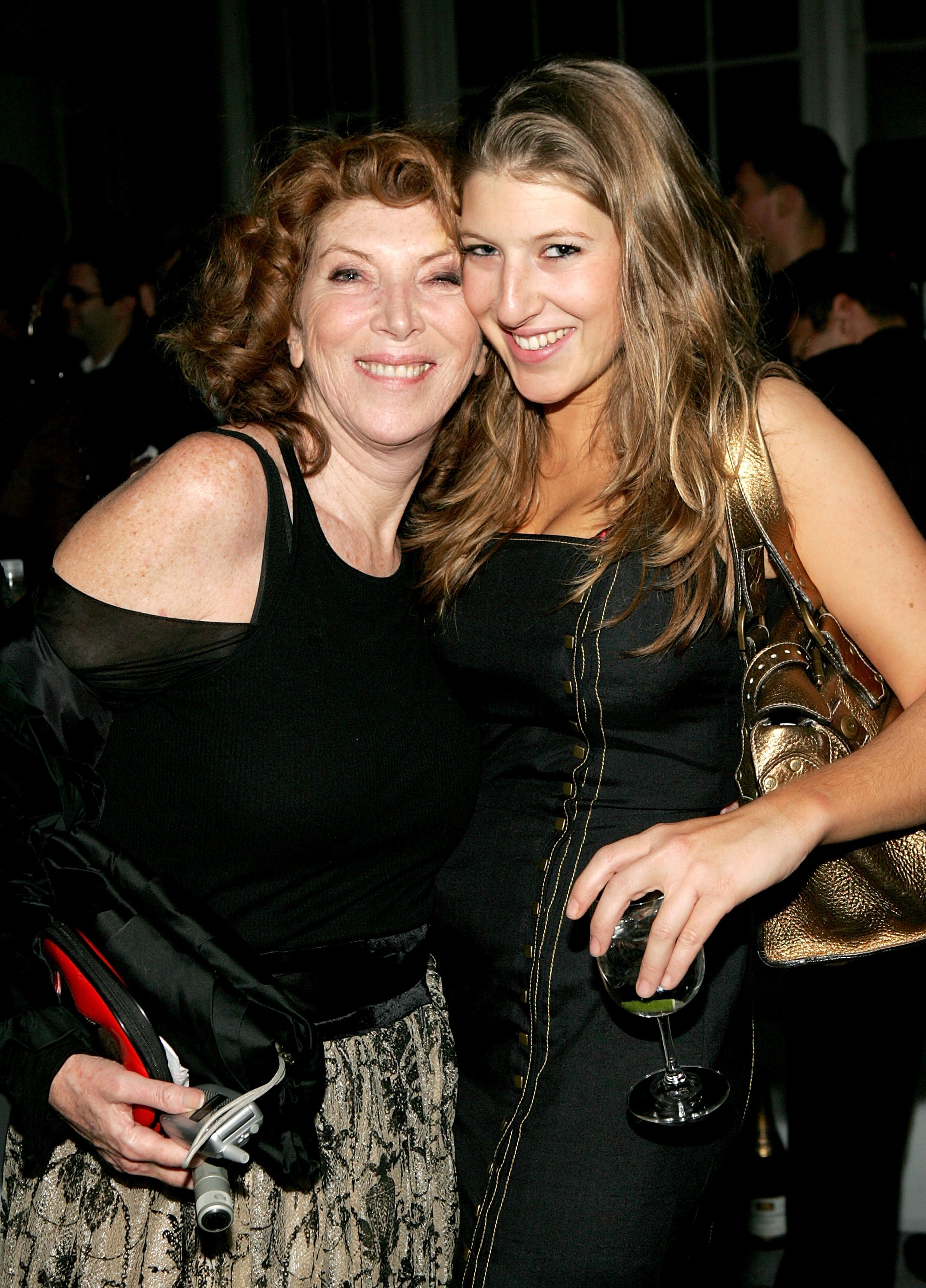
Nona had an astonishing volume of tumbling red curls, a lightning-quick brain, and a fearless sense of enterprise. She had that kind of nonchalant ease that soothes the famous and brings the world to heel, and a jet-set fluency in five, six, maybe seven languages, including Japanese, which she picked up on a trip to Tokyo with her later lover, director Michael Lindsay-Hogg.
The glamorous and faintly louche dinner parties she and Martin Summers gave in their Glebe Place house – four artists’ studios joined up and decorated in high Renzo Mongiardino style – would be filled with movie stars and rock stars trying not to break the rare Bugatti furniture. This was the late 1970s and early 1980s, marking the high point of rich London bohemian hedonism. Never missing a trick, she also turned part of Glebe Place into an exercise studio and designed 1980s leotards with shoulder pads. Another studio became the nursery for their daughter Tara.
After Nona’s affair with Lindsay-Hogg broke up her marriage, she moved around the corner to a small house with more Mongiardino wallpaper, large furniture to help her steer, and a flat roof where she held smaller parties, some with fireworks. Her daughter Tara recently recalled how one year the police actually came in to stop them firing rockets from the roof, and had to contend with a guest who had a thing for men in uniform, asking to be handcuffed. The police were so shocked they scuttled out.
The stars remained her friends. Tara’s godparents are Diane von Furstenberg and Jack Nicholson. Anjelica Huston met Nona in London when Nicholson was shooting The Shining. “Nona was all in purple, with purple eyeshadow that matched her pants, which were purple leather. I thought, ‘What’s this?’” remembers Huston. “The next day, Nona called, exclaiming: ‘Flagrante delicto! Flagrante delicto! I’ve caught Martin red-handed! He was in the park with his secretary, and now I can buy that coat at Browns I was telling you about!’ I fell in love with her immediately.” Nona always called Anjelica by Nicholson’s nickname for her, Tootie. “She spelled it Tutti, like the ice cream,” says Huston.
In her lifetime, Nona was compared to Lady Caroline Lamb and Madame Sans-Gêne, and many believed her to be the inspiration for Edina Monsoon in Absolutely Fabulous. However, Edina the PR was a career woman, while Nona’s elegant panache and lack of a day job made Edina look like a dutiful striver in Lacroix.

Born to Austrian parents, Nona was more like Mrs Stitch in Evelyn Waugh’s Scoop, the society lady of “dazzling, inebriating charm” who drives her little car down the stairs of the men’s lavatory on Sloane Street; or Lady Pauline Leone in Nancy Mitford’s Don’t Tell Alfred, who refuses to vacate the British Embassy residence when her husband’s turn is up. Both Waugh’s Mrs Stitch and Mitford’s Lady Leone were based on Lady Diana Cooper (née Lady Diana Manners, 1892).
However, Nona’s aristocratic disregard for rules did not mean she was an aristocrat. Her mother, Fritzi, had fled Austria after the Anschluss and was so intent on the royal flush she’d been dealt in a poker game that legend has it she gave birth under the card table, naming the baby Nona because she was born on 9 March.
A bridge champion back in Vienna, Fritzi Leist married Paul Geist, a fan who changed his name to Gordon after arriving in England, where he worked on board games for Waddingtons. Fritzi Gordon became one of the first female grandmasters of the World Bridge Federation and had many lovers. Nona, in later years, often wondered if Paul Gordon was really her father.
Fritzi’s most enduring partnership was the world-famous bridge team she formed with Rixi Markus, who also fled Austria just in time. Her skill in navigating chance to coax luck were Nona’s gifts from her mother. She needed them because Fritzi, whose playing style was described by Victor Mollo in The Bridge Immortals as “icy cold… merciless efficiency”, put Nona in a British boarding school near Eastbourne, then in a Swiss one at Château d’Oex.
Nona’s survival charms were her charisma, enthusiasm, and constant appetite for joy. During a brief spell learning to be an interpreter at the University of Geneva, she forged a lifelong friendship with a Belgian girl named Diane Halfin, who would soon marry Prince Egon von Furstenberg and become famous for wraparound dresses. Von Furstenberg recalls her first sight of Nona dancing in a nightclub: “Looking like a flame with her red hair.”
Nona, bored, left university before she was 20 to work in Hollywood and around the world for her mother’s bridge-playing friend, the movie star Omar Sharif. She followed that with light magazine jobs – Harper’s Bazaar Italia, Town and Country, British Vogue – and started writing a hilarious memoir.

When I edited Paris Vogue, I sent Nona to do fun things because few French writers had her uncritical attitude to joy. She turned in a piece on a spa that included the phrase “I was reborn”. The translator didn’t know how to cope with the concept of having been reborn. In French, you can say, “I underwent a renaissance,” which is not quite it; “I was born again” sounded evangelical, or “Je renacquis,” which wouldn’t do at all. Half the staff tried to say “I was reborn” in French, but it kept coming out “Je suis Renée,” which was nonsense.
In a simple piece about a spa, Nona Summers had opened up a week-long controversy about the French attitude to death, the afterlife, the rapture, and reincarnation.
At the time of her death, Nona was fulfilled and happy: she had just been to Morocco for the marriage of her beloved daughter, Tara Summers, to Anthony Shrubb, at the Marrakech house of her former husband, Martin. She had sold her improbably glamorous little Hollywood house, where she had transformed the garage into a guest room and applied her style (half Italian decorator, half props from the movie set emporium Nick Metropolis) to the volumes and contours she came to know by heart. This was where, against all odds, she still cooked many Sunday lunches for friends and sat happily in the small brick-paved garden listening to birds and inhaling the jasmine.
How she will be missed.
Nona Gordon Summers, 9 March 1947–28 August 2025
Tara Summers has started a fundraiser so that the Burns Intensive Care Unit at Broomfield Hospital can create a private garden where burn patients can sit outside with flowers and birds, shielded from the gaze of strangers. Visit https://nonasummers.muchloved.com
Join our commenting forum
Join thought-provoking conversations, follow other Independent readers and see their replies
Comments
Bookmark popover
Removed from bookmarks