America is now the unreliable partner the UK really needs to worry about
Keir Starmer talks up Britain’s nuclear deterrent, but behind the rhetoric lies a military dangerously dependent on American systems, underfunded conventional forces and an outdated defence strategy, says Robert Fox


Making his sonorous statement about standing by Greenland and Denmark’s sovereignty in Downing Street this month, Keir Starmer held up Britain’s nuclear deterrent as the symbol of its military strength and independence.
He might have done well to recall a cautionary tale from a visit by defence correspondents to the nuclear submarine base at Faslane a few decades back – now the stuff of legend. Journalists were invited to see new facilities during the upgrade from Polaris to Poseidon missiles. Asked to wait in a side office, they noticed posters showing missiles adorned with Hertz “car hire” stickers – from an American car company that was leasing cars to anyone posted there. On enquiry, a waggish matelot told them words to the effect that it was only appropriate given “nearly all the missile system right now is on loan and hire from the US”.
The news leaked fast – possibly via the local broadcasters. By the time the defence hacks returned to base in London, the “Hertz hire” missile system was an urgent question, and heated words were exchanged in the Palace of Westminster.
Then, as now, large parts of UK defence – its systems and kit – are in hock to the Americans. As Starmer heads to China for a high-level state visit this week, it is our relationship with our nearest allies that is worrying the defence establishment. All three services depend on the United States in one way or another. Key programmes require American goodwill – which is often in conspicuously short supply.
Without that support, Britain’s capacity to defend the British Isles’ home territory by sea and air is close to negligible. Acting alone, the UK has little ability to fend off intrusion by air or sea – whether by drone, underwater sabotage, submarines or attacks designed to disrupt key communications, energy and fuel supplies. At any one time, Britain holds food stocks sufficient for just 10 days, were it to be cut off completely.
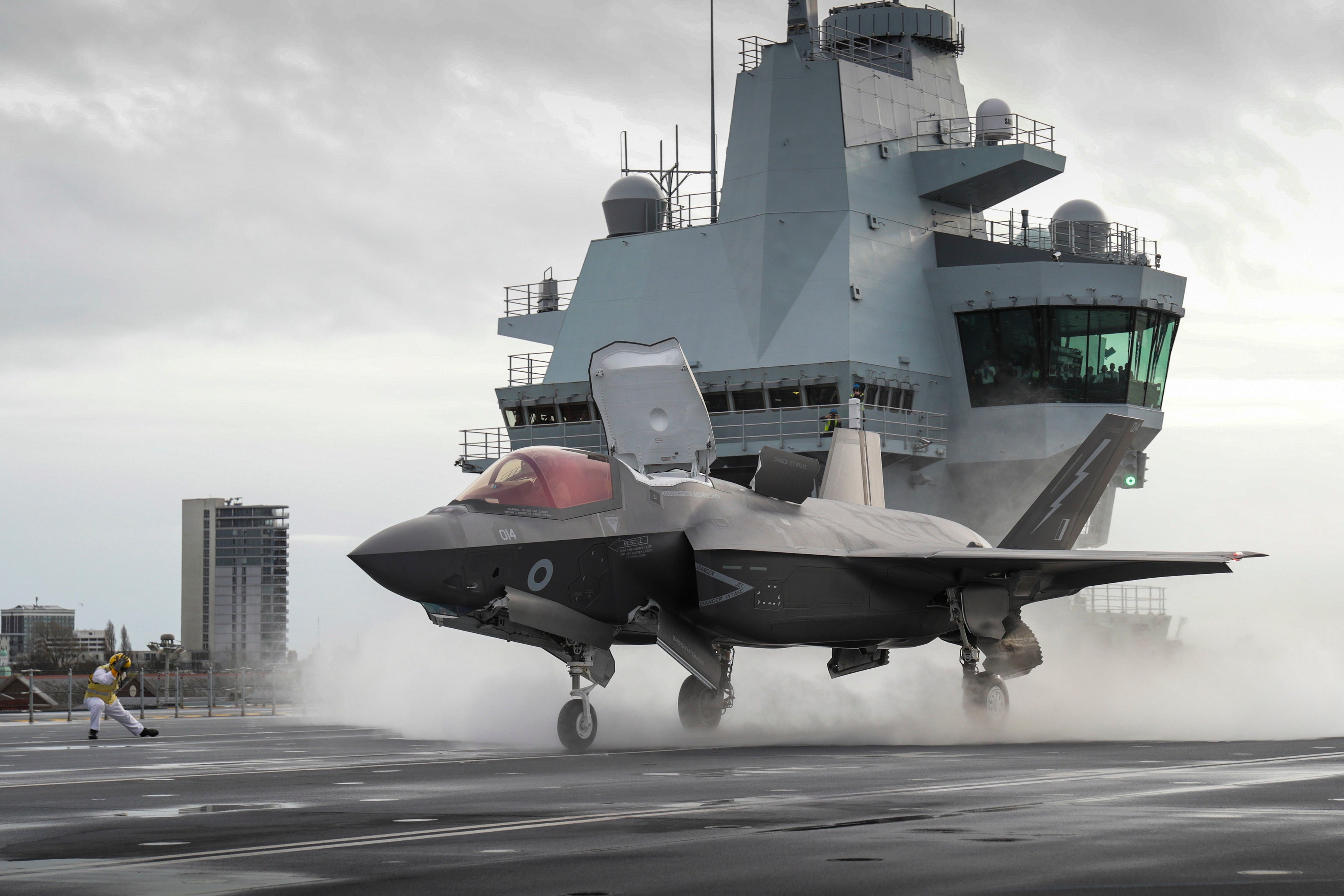
The F-35 Lightning II fighter for the RAF and Royal Navy is perhaps the most glaring example of how the system would unravel without the Americans. It is expensive and, in the F-35B version, limited in range and payload. The aircraft rely on the US for long-term maintenance and upgrades. Despite the UK’s status as a “level one” partner, responsible for 14 per cent of the aircraft’s manufacture, British forces do not receive the full range of cutting-edge capabilities supplied to US variants.
There is a further problem, and it is mind-boggling. The central node for software and radar systems is located in the United States. When a Royal Navy F-35 on exercise in the Indian Ocean suffered a mechanical failure and was forced to divert to Kerala in India, it was deemed to be isolated in a potentially hostile country. The aircraft’s systems were automatically wiped. It took weeks to get US software engineers to restore them.
US command claims to retain a “kill switch” over the radars and software not only of the Lightnings but also of RAF Eurofighter Typhoons, though this is disputed in Whitehall.
The deeper problem for Britain’s defence forces – and its foreign policy – is the absence of credible conventional deterrence. European allies accept that Britain, alongside Germany and France, should form the “E3” leadership of Europe through Nato and the EU. Yet today Britain is militarily less credible than either. Decades of neglect have left the forces hollowed out, undermanned and underfunded. The British Army possesses just enough kit – much of it obsolete – for a force of around 20,000, not the 72,000 personnel currently under arms.
Reliance on the Trident system for nuclear deterrence – the essence of Starmer’s boast in his No 10 address – is strategically crippling. It absorbs nearly a third of the UK defence operational budget, draining resources urgently needed for future development in communications, AI and autonomous systems. Provisions for these areas in the recent defence review are barely nugatory.
There must be a workaround. One option would be to place nuclear systems into a single shared framework with France, alongside other interested European partners such as the Netherlands, Germany and Italy.
The doctrine of nuclear deterrence is now 80 years old. It has hardened into dogma, becoming an obsession that actively impedes tackling the emerging disciplines such as AI, autonomous weapons on earth and in space, and quantum computing. The era of the killer robot is already upon us. Yet the Defence Review allocates an experimental budget of just £200m for AI.
In his bluster and gratuitous incivility, US president Donald Trump may have done Britain and Europe an unintended favour. His behaviour has forced a reckoning. We must think seriously about our own resilience, strategy and defence – British and European alike. That thinking must be sober and realistic, because the Trumpian view of America’s role in the world is volatile and hyperbolic. Nothing should be off the table – including reducing over-dependence on the US and reassessing reliance on the Anglo-American nuclear deterrent.
Join our commenting forum
Join thought-provoking conversations, follow other Independent readers and see their replies
Comments
Bookmark popover
Removed from bookmarks