Is this the endgame for Iran’s ayatollahs?
Deadly protests in Iran over the past week have been, in places, openly political and nostalgic for the Shah. We have been here before, but regimes fall gradually, then suddenly, writes Mary Dejevsky

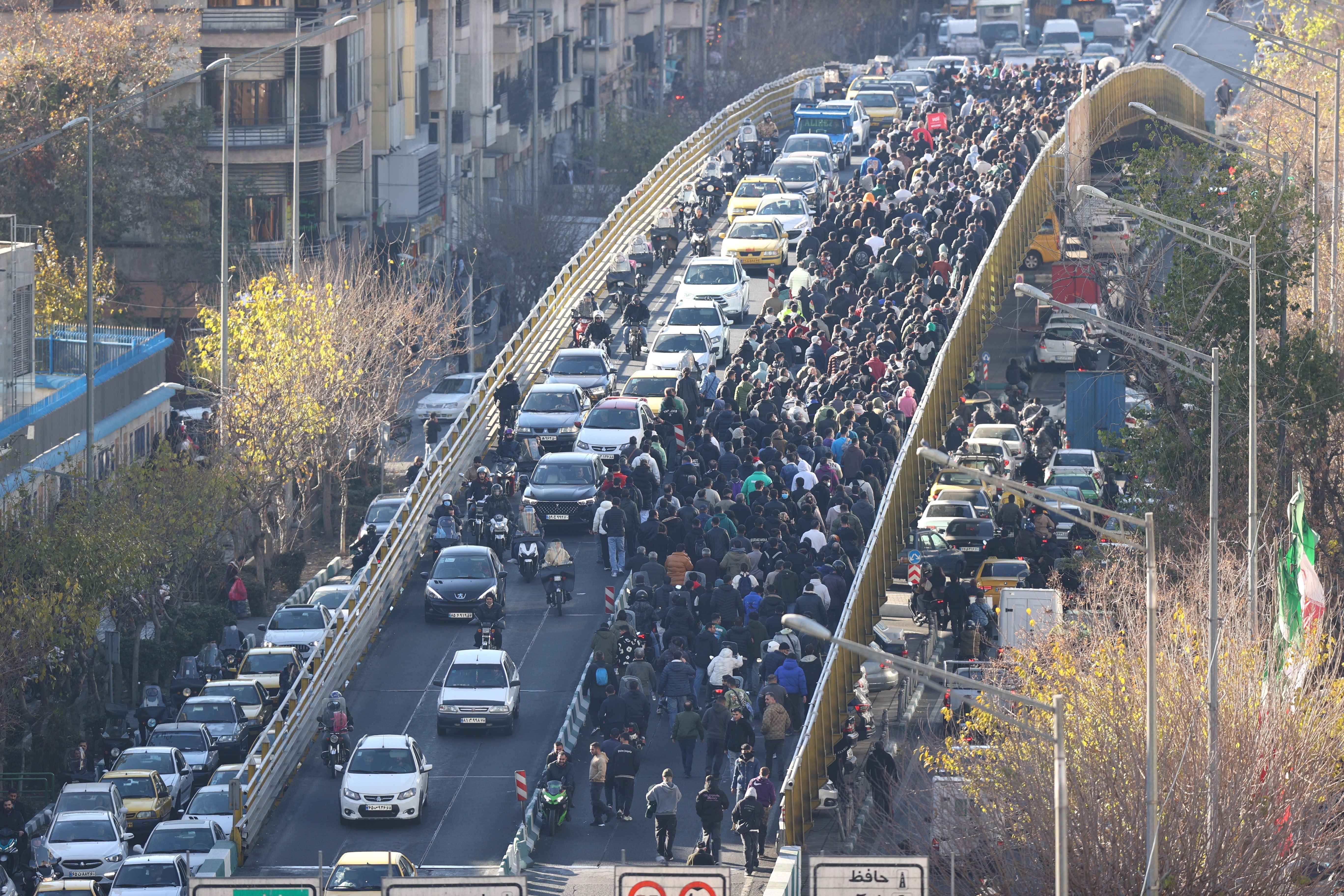
For the best part of 50 years, almost the only part of the Middle East to have remained seemingly, if deceptively, static has been the rule of the ayatollahs in Iran. That could be about to change, with the possibility of regime-change or chaos, or both, and potentially far-reaching implications for the country, the region, and beyond.
Over the past week, large street protests have erupted in Tehran and rapidly spread across the country – to the east, west and south. The immediate causes are economic: a near 60 per cent depreciation of the Iranian currency against the US dollar over six months; shortages of fuel and domestic energy; and galloping inflation that has raised many food prices by more than 70 per cent, leaving many without the means to maintain their already depressed standard of living.
Whereas previous protests – specifically those of 2022, sparked by the death in custody of Mahsa Amini, a young woman accused of wearing her hijab incorrectly – were restricted to a single cause and generally confined to educated activists in the capital, the latest protests have gone far beyond Tehran and are already attracting a much wider demographic. Bazaar-traders and small shopkeepers have been closing their businesses to join protests; middle-class workers, as well as students, have all joined the demonstrations. And those demonstrations have in places taken on a directly political, anti-regime flavour, with slogans demanding an end to the rule of the ayatollahs and even, in some instances, nostalgia for the Shah.
Now it is entirely possible that this surge of unrest will turn out to be only the latest in a gradually intensifying sequence of disruption that still has a way to go before the theocratic regime comes to an end – if it ever does. But it is also worth noting that revolutions, when they happen, can appear almost out of nowhere, escalate out of all proportion and tip the regime to collapse. Undemocratic regimes can evince every sign of being in power, until suddenly they aren’t.
Such was the popular movement that propelled Ayatollah Khomeini to power on his return from foreign exile in 1979. It took just 10 days from Khomeini’s return to the toppling of the monarchy, and another two months before a referendum confirmed Iran as an Islamic Republic. Could it be that, nearly three generations on, the appeal of theocracy has run its course, and with it, its hold on power?
That is a prospect that should not be ruled out, but there are gradations of what could happen next. Iran’s Revolutionary Guard has not in the past fought shy of brutal enforcement, as happened in 2022, when violent suppression led to the women’s rights protests gradually petering out, and it is applying the same techniques of physical and political repression now. But how far are the Revolutionary Guard and its theocratic masters prepared to go? Do they have the will or, more to the point, the capability to embark on something akin to a Tiananmen Square “solution”?
Several factors seem to militate against that. It is far harder now than it was four decades ago to insulate a country and its protesters from the outside world. Iran has an active and patriotic diaspora. The ayatollahs are now elderly, and their authority appears to have been weakened by the US and Israeli attacks of last year, now known as the 12-day war. Discontent about living standards is almost universal.
Contrast two eras in Russia. The combination of the Afghan war and its aftermath, steep defence spending, and economic dislocation helped sink the Soviet system, but Putin has been cannier and luckier, keeping Russians on side over the Ukraine war by, for the most part, maintaining living standards and withstanding Western sanctions. Iran faces that lethal duo of military defeat sapping national morale and sanctions progressively crippling the economy.
If regime-change is in prospect, there is one possible bulwark against chaos, in the figure of Iran’s elected president, Masoud Pezeshkian. As the first protests broke out last week, he appeared to appeal to the ayatollahs for a response and said his government would listen to the “legitimate demands” of the protesters. But the strength of resentment against anyone associated with authority could mean that his heyday may have already come and gone – an eventuality that the West has, perhaps inadvertently, helped on its way.
Brought to power indirectly by a helicopter crash that killed his predecessor as president, Pezeshkian – a one-time military surgeon – made an unusual overture to the outside world in his 2024 address to the UN General Assembly, soon after his election. But it was an overture that was either ignored or rebutted by those for whom it was intended. An opportunity was lost, and Iran turned back in on itself. It is not clear whether Pezeshkian has the clout or the personal drive to take charge amid Iran’s current volatility.
After years in which it has treated Iran as something between a regional outlier and a rogue state (for what are widely seen, but denied by Iran, as its nuclear ambitions), the outside world must suddenly now confront the possibility of sharp change in Iran, sooner or later in the current year. A chaotic Iran could encourage its neighbours – Iraq and Turkey in the first instance – to nibble small pieces for themselves, triggering new regional conflicts. Israel is already threatening a new assault on Iran’s military capabilities, however much or little is left, and the US could join in, claiming the need to secure the world against “loose nukes” or a new nuclear power on the block.
But unrest in Iran heralds as much opportunity as threat. If what emerges is an Iran whose weapons are subject to international control, an Iran that ceases troublemaking elsewhere in the region, an Iran wanting to re-engage with the world and return to the domestic modernisation project that was interrupted by the Islamic Revolution, that could represent a hugely positive change.
For as long as Iran’s future direction remains uncertain, the outside world would do well to remain on the sidelines, remember that Iran is an ancient civilisation, with a strong sense of its own national identity, and do nothing that would insult its dignity. The new year could already be offering a once-in-a-generation chance to improve the state of the world in one very particular respect – and if it is an opportunity, it should not be lost.
Join our commenting forum
Join thought-provoking conversations, follow other Independent readers and see their replies
Comments
Bookmark popover
Removed from bookmarks