Ukraine-Russia war: Zelensky calls Putin ‘slave to war’ in Munich as he ramps up demands on US for peace deal
Ukrainian president says US ‘too often’ asks Kyiv rather than Moscow for concessions
Volodymyr Zelensky denounced Vladimir Putin as a “slave to war” while seeking security guarantees for Ukraine.
“He may see himself as a tsar but in reality he is a slave to war,” the Ukrainian president told the Munich Security Conference, referring to the Russian leader.
Zelensky acknowledged he was feeling "a little bit" of pressure from Donald Trump after the US president told Ukraine’s leader not to miss the opportunity to make peace and urged him "to get moving".
He complained that the US too often asked Kyiv rather than Russia for concessions while renewing his call for 20-year security guarantees.
“The Americans often return to the topic of concessions and too often those concessions are discussed only in the context of Ukraine, not Russia," Zelensky said.
He confirmed the US had proposed 15-year security guarantees, although Ukraine wanted at least 20 years.
Earlier at the conference, Britain accused Russia of killing opposition leader Alexei Navalny with a poison developed from a dart frog toxin.
Moscow, however, denounced the allegation as a Western “disinformation campaign” against it.
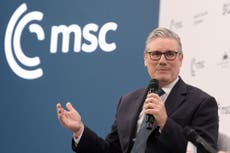 Starmer to deploy UK warships to Arctic following Trump’s Greenland threats
 Navalny died after being poisoned with dart frog toxin by Russia, UK says
 Drone strikes claim lives in Ukraine and Russia ahead of fresh peace talks
 UK and Europe depend on each other for security, Starmer says at Munich summit
 Starmer has grasped what his predecessors would not – that Britain is better off in Europe than with the US
Russia takes village in Zaporizhzhia region
Russia's Defence Ministry said on Sunday that its troops have taken the village of Tsvitkove in Ukraine's southeastern Zaporizhzhia region, state news agency TASS reported.
Russia controls about 75 per cent of the Zaporizhzhia region, but battle lines had been largely static since 2022 until recent Russian advances
New sanctions for Russia could follow Britain blaming Kremlin for poisoning Navalny
New sanctions against the Russian regime could follow from Britain and its allies blaming the Kremlin for poisoning opposition leader Alexei Navalny, the Foreign Secretary has suggested.
Asked on the BBC’s Sunday With Laura Kuenssberg programme what the consequences of the accusation would be, Yvette Cooper said: “We continue to look at co-ordinated action, including increasing sanctions on the Russian regime.
“As you know, we have been pursuing this as part of our response to the brutal invasion of Ukraine, where we are also coming up to the fourth anniversary of that invasion as well.
“We believe that it is the partnerships that we build abroad that make us stronger at home. It is by acting alongside our European allies, alongside allies across the world, that we do maintain that pressure on the Russian regime.”
She added: “The other thing that I would say specifically about Alexei Navalny is one of the things he said was ‘tell the truth, spread the truth’, because that is the most dangerous weapon of all.
“That was his comment about the Russian regime. He is no longer able to do that, but that is why we are continuing to do that for him, and for his widow as well.”
'European bashing is very in fashion', Kallis says
Kaja Kallis, the EU’s high representative for foreign affairs and security policy, has responded to Marco Rubio’s speech yesterday.
At the Munich Security Conference, Rubio suggested that the West’s victory in the Cold War had fostered complacency in Europe and said the US needed the continent to be strong.
Kallis said on stage today: “Every time I hear this European bashing, it’s very in fashion right now, I’m thinking of what is the alternative.
“I mean, all the best or good things that we got from Europe, and all the good things that Europe actually represents.”
However she welcomed Rubio’s comments that the US and Europe “will always be intertwined”.
He said on Saturday that Donald Trump “demands seriousness and reciprocity from our friends here in Europe” because “we care deeply about your future and ours”.
Kallis said: “The message that we heard from there is that America and Europe are intertwined; have been in the past and will be in the future.
“I think this is important. It is also clear that we don’t see eye to eye in all the issues and that this will remain the case as well, but I think we can work from there.”
Poison Russia used to kill Navalny can be produced synthetically, says Cooper
Ukraine seeks 20-year US security guarantee before signing peace deal
Volodymyr Zelensky has said Ukraine wants a legally binding US security guarantee lasting at least 20 years before signing any peace deal with Russia.
Speaking in Munich ahead of fresh talks next week, the Ukrainian president said Washington had so far offered a 15-year commitment, but Kyiv was seeking a minimum 20-year agreement setting out the specific help the US would provide to a planned European reassurance force inside Ukraine.
“We want a minimum 20-year, legally water-tight agreement,” Zelensky said, warning that any deal must include clear and enforceable guarantees.
He added that US officials had suggested peace could come more quickly if Ukraine withdrew from the Donbas region, but said such a concession was not possible because Ukrainians live there.
Zelensky also called for a clear date for Ukraine’s accession to the European Union, saying membership would provide additional long-term stability.
The comments come ahead of US-brokered talks between Ukraine and Russia expected in Geneva next week, where territorial concessions and security arrangements are likely to dominate discussions.
Cooper says Cold War peace dividend ‘has gone’ after Navalny announcement
Whitehall editor Kate Devlin reports:
The foreign secretary told the BBC: “The Cold War peace dividend we had all believed in and hoped for has gone.”
She said the Russian threat to European and UK security “is back”.
Her comments came after the UK accused Russia of killing opposition leader Alexei Navalny with a poison developed from a dart frog toxin.
Cooper: 'We do know that the Russian regime has had possession of this particular chemical'
Yvette Cooper told Sky News’ Trevor Phillips that the lethal toxin Epibatidine which Britain and its allies said was used by Russia against opposition leader Alexei Navalny can be produced synthetically.
Epibatidine is produced by wild dart frogs in South America.
Ms Cooper would not be drawn on whether the toxin the UK says was used on Navalny was produced synthetically.
The foreign secretary told Sky News: “I can’t tell you the details of that, but as you say, this is a particular chemical.
“It can be produced synthetically, it can also be found in this particular frog in Ecuador.
“We do know that the Russian regime has had possession of this particular chemical. It is obviously not one which is found naturally in Russia.”
Cooper: UK 'strengthening defence in partnership with Europe'
Asked by Sky News’ Trevor Phillips about transatlantic security ties and Sir Keir Starmer’s comments in Munich about the UK’s relationship with Europe, Yvette Cooper said the UK “had to do more”.
The foreign secretary said: “That transatlantic partnership remains very important but we have to do more ourselves as well.
“One of the things for example, the UK is doing with Norway is developing a new fleet of joint frigates that can strengthen our maritime security - that means recognising the threats from the Russian northern fleet that is to the north of Norway and through the arctic as well.
“We’re doing that direct with Norway and we’re going to need to go further - strengthening our defence in partnership with European countries because that is where some of the threats, particularly from Russia, are most felt.”
Odesa hit with further drone strikes
On Saturday, drone strikes killed one person in Ukraine and another in Russia, Ukrainian officials said, ahead of fresh talks next week in Geneva aimed at ending the war.
An elderly woman died when a Russian drone hit a residential building in the Black Sea port city of Odesa, Ukraine's State Emergency Service said.
In Russia, a civilian was killed in a Ukrainian drone strike on a car in the border region of Bryansk, regional Gov. Alexander Bogomaz said.
Russia-installed authorities said a Ukrainian airstrike on a village Saturday wounded 15 people in Ukraine's partially occupied Luhansk region.
The attacks came a day after a Ukrainian missile strike on the Russian border city of Belgorod killed two people and wounded five, according to regional Gov. Vyacheslav Gladkov.
On Sunday, Reuters also reported that firefighters were working to extinguish a huge fire at the site of a railway infrastructure facility hit during overnight Russian drone strikes in Odesa
Zelensky says it is “crucial” Geneva talks are productive
Volodymyr Zelensky has said it is “crucial” that upcoming talks in Geneva deliver results, as diplomatic efforts to end the war intensify.
In a post on X after meeting US secretary of state Marco Rubio, the Ukrainian president said: “It is crucial that the talks planned in Geneva be productive, and I thank the United States for their constructive approach.”
Zelensky said he briefed Rubio on the situation at the front, ongoing Russian strikes and the impact of attacks on Ukraine’s energy system. The two also discussed “how to help Ukraine protect lives during the winter cold and strengthen our resilience”.
He added that they had held a “detailed discussion about the diplomatic process and trilateral meetings”, including the sequencing of steps in negotiations. “It is important to make progress on the issues of security guarantees and economic recovery,” Zelensky said.
Fresh US-brokered talks between Ukraine and Russia are expected in Geneva next week.
Join our commenting forum
Join thought-provoking conversations, follow other Independent readers and see their replies
Comments
Bookmark popover
Removed from bookmarks