Is Iran heading for its ‘Venezuela moment’?
In sending a ‘beautiful armada’ towards the Middle East, Donald Trump has revealed how he expects his gunboat diplomacy to play out – and it’s bad news for the millions of ordinary Iranians who believed US support to overthrow their brutal theocracy was on its way, says Mary Dejevsky


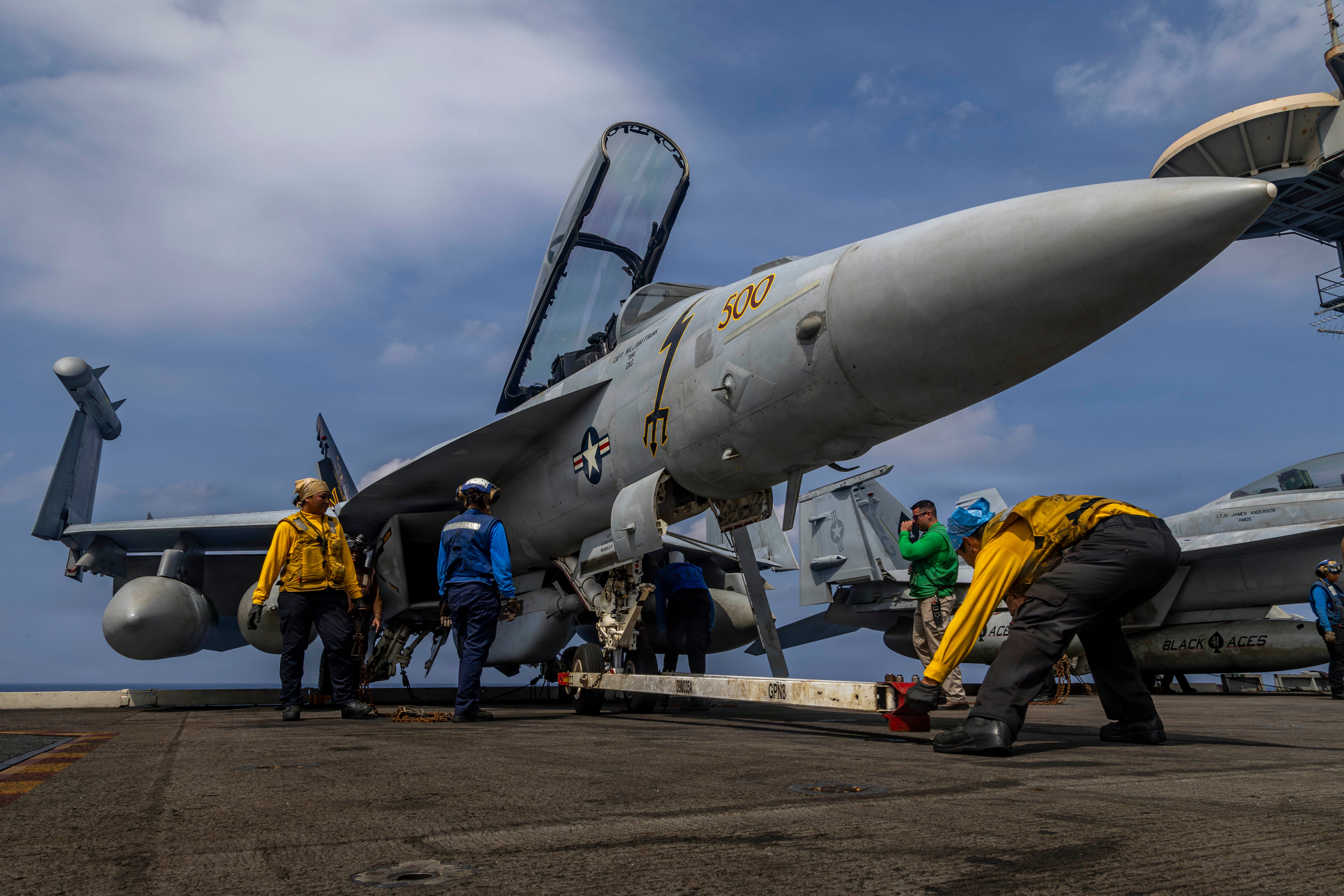
There’s another beautiful armada floating beautifully toward Iran right now…” So the US president informed an audience at a rally in the Midwestern state of Iowa, and, via his usual social media megaphones, the world.
Those who track such things have produced maps showing an impressive amount of US military, mostly maritime hardware, converging on the region. Presumed message: Stand by, oh ye ayatollahs, for an all-out US military assault and a possible end to your rule.
Cue a belligerent, in-kind response from Iran’s foreign minister, saying the country’s armed forces were ready “with their fingers on the trigger” – as well as panic alarms all around the region, and among the United States’ European allies, about an imminent US-Iran war.
Nor can such a dramatic and potentially destabilising outcome be ruled out. At the same time, however, Donald Trump went on to spell out how it could be avoided. Iran’s leaders had to quickly “come to the table” and “negotiate a fair and equitable deal – NO NUCLEAR WEAPONS”.
In other words, Iran’s regime could survive, for the time being, at the price of swingeing constraints on its already severely curtailed regional power.
Now, there are several points that could be made here, starting with the obvious: that it is at least in part – even mainly – Trump’s fault that Iran is not signed up to international controls on what might remain of its nuclear capability. It was he, after all, who withdrew the US from the Joint Comprehensive Plan of Action (JCPOA), otherwise known as the Iran nuclear deal, halfway through his first term, over the misgivings of the UN and the Europeans. That withdrawal came with the re-imposition of sanctions that arguably helped produce the economic discontent behind the recent protests in Iran.
Trump could also be accused of performing an about-turn – another about-turn. Having offered to “rescue” Iran’s protesters before they were so brutally repressed, he is now appealing, in his own inimitable way, to the very leaders they were trying to displace, in order to neutralise Iran as any sort of military threat.
So which is it, you might well ask? Threatening the overthrow, or shoring up Iran’s leaders? And either way, do we not have here yet another Trump about-turn?
By way of an answer, let me offer two phrases – “America First” and “the art of the deal” – to be followed by a study of two recent official US documents, both succinct and eminently readable, setting out the basic objectives of US foreign and defence policy under Trump.
What we are watching with Iran, and not for the first time, is Trump’s method – his way of achieving those objectives. And this is not, in the expression coined by some of his US detractors, “Taco” – Trump always chickens out – but the word he used in rejecting that description: “Negotiations.” Negotiations, it might be added, that often come with a certain old-fashioned prelude in the form of gunboat diplomacy: the deployment of power to intimidate and deter.
In talking about the “armada” heading for the Middle East, Trump dropped a clue that he sees Iran through the same prism as Venezuela. There, he offered talks and then threats before seizing the president and his wife by force, leaving behind a headless and shellshocked administration more easily controlled by Washington.
Still not convinced this could be the playbook to use with Iran? Trump has already boasted that the naval force in the Gulf is a great deal larger than the one he sent to Venezuela.
For all the Europeans’ insistence that they forced Trump’s “climbdown” on his claim to Greenland, it is not at all clear that the implied threat of force or new tariffs were more than opening gambits for negotiations – as indeed his worldwide tariffs of a year ago turned out to be. The only genuine climbdown or about-turn I have observed from Trump is his not-quite-an-apology following what Keir Starmer described as the “insulting and appalling” remarks he made about British and other troops who served with Nato in Afghanistan: he later praised UK troops as “brave soldiers”.
As a rule, Trump seems to shy away from operations that demand boots on the ground, the long-term commitment of troops, and uncertain outcomes. All the uses of military force so far in his second term have been highly limited in time and scope, and based on a fine calculus of risk versus reward. While some expected the Venezuela operation to entail regime change, that is not what happened. The regime was decapitated, not overthrown.
As so far in Iran, Trump also rejected any plan to install an exiled opposition figure, saying in both instances that it was not clear that the most obvious frontrunners – Venezuelan opposition leader Maria Corina Machado, who handed Trump her Nobel Peace Prize medal at the White House, and Reza Pahlavi, the exiled crown prince of Iran – commanded enough public support. If Trump has taken that lesson from past US interventions in Afghanistan, Iraq and Libya, so much the better.
Some favoured advice from observers of Trump’s first term was that his words should be taken seriously, but not literally. Another way of putting it might be to argue that he uses maximalist language, while tempering his actions to what he judges to be feasible or realistic. As with Venezuela, so with tariffs, so with Greenland, and now with Iran, the threats have to be plausible. The desired results have also to be seen to be in America’s best interest – hence, perhaps, the apparent to-ing and fro-ing on Iran and on Ukraine, which is increasingly seen by the US as a problem for Europe.
Trump’s approach to China – as set out in the US National Defense Strategy – is also less hawkish than that of past US presidential or congressional pronouncements. It says that China will now be dealt with by “strength, not confrontation”, and specifically that the US does not “seek to dominate, humiliate or strangle China” – but wants “a decent peace, on terms favourable to Americans but that China can also accept and live under”.
Taken together, what is clear from this is that power relationships reign supreme, and that US interests, as perceived by Trump and his coterie, come first, along with the security of the western hemisphere.
It is possible for the calculus of US interests to shift, as it did in Iran, where the regime demonstrated its determination and ability, for the moment, to remain in power. Such adjustments are not climbdowns or about-turns, but reflections of Trump-style realism, with – always – America first.
Join our commenting forum
Join thought-provoking conversations, follow other Independent readers and see their replies
Comments
Bookmark popover
Removed from bookmarks